Strategy 2027–2030 · Eastern Congo

Our Strategy 2027–2030

For peace to hold in eastern Congo, reconstruction must be clean: honest public servants coming back, schools and health centres rebuilt and given back to the people, public revenue collected digitally and accounted for, and every dollar of aid – including emergency health funds – reaching where it should.

Download the strategy (PDF) Our Approach

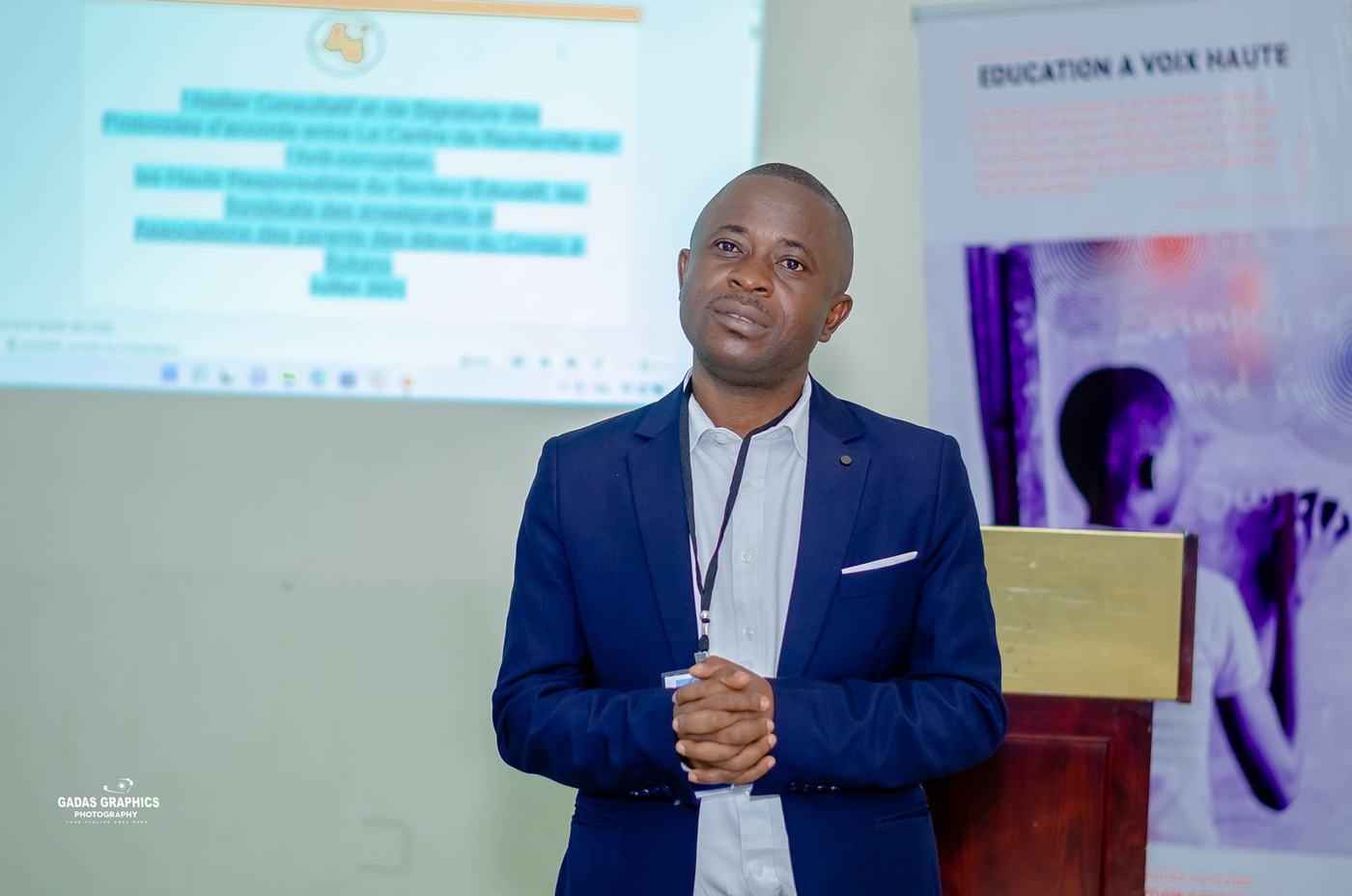
A speaker at the consultation workshop on integrity education, Kinshasa, July 2022

Why a new strategy

Eastern Congo is coming out of war. After AFC/M23 withdrew from Uvira in January 2026, the Government launched the progressive restoration of State authority in South Kivu, with Uvira as its pilot city; on 21 September 2026 the Deputy Prime Minister for the Interior opened a community workshop there on the return of the State. Administration, schools, health centres and public revenue now have to be rebuilt – in a province where war has made corruption worse and where control mechanisms barely exist. Now is when it all happens.

  • 20/100 for integrity

    The DRC ranks 163rd of 182 countries in the Corruption Perceptions Index: among the countries perceived as most corrupt.

    Transparency International, CPI 2025

  • 84% of revenue lost

    Up to US$17 million a month in taxes was raised by the AFC/M23 during the M23/Rwanda occupation, and South Kivu lost 84% of its provincial revenue.

    Governor of South Kivu, April 2026

  • US$33M lost every month

    Up to US$33 million a month is reported lost to fraud, dumping and leakage of revenue at the borders of South Kivu.

    Ministry of Foreign Trade, June 2026

  • US$700M+ of Ebola funds untraced

    Of the US$962 million disbursed by donors for the Ebola response, more than US$700 million could not be traced to the organisations on the ground.

    Africa CDC, October 2026

  • 1,768 schools closed

    The fighting has closed 1,768 schools in South Kivu, leaving more than 688,000 pupils out of school.

    OCHA, quoted in February 2026

  • 536 classrooms destroyed

    536 classrooms have been destroyed in 66 schools, and 104 schools are occupied by displaced people.

    Ministry of Education, March 2025

Six problems that reconstruction must solve

A post-conflict east

Years of fighting in North and South Kivu have displaced families, emptied schools and cut provinces off from the State. The return of the administration is starting in Uvira, but security remains fragile and the institutions have to be rebuilt almost from scratch.

War amplifies corruption

In war, whoever holds the road levies the tax. Armed groups taxed trade and the population – up to US$17 million a month for the AFC/M23, according to the governor – and illegal checkpoints remain: on the RN5 between Kamanyola and Baraka, travellers pass nearly ten barriers and pay at least 5,000 Congolese francs at each.

Weak governance, no controls

With a score of 20/100 in the Corruption Perceptions Index, the DRC is among the countries perceived as most corrupt. In the east, inspection services, courts and audit bodies are often absent: public money and posts can be diverted without anyone noticing.

Schools and health centres destroyed

Classrooms destroyed or occupied, health centres looted – four were destroyed in Masisi in October 2026, and the Birambizo hospital was looted on the day it reopened. Reconstruction money will arrive fast: without monitoring, part of it will never become a school or a health centre.

Emergency health funds that cannot be traced

During the 17th Ebola epidemic, declared in May 2026 and spread to North and South Kivu, donors disbursed US$962 million – but more than US$700 million could not be traced to the organisations on the ground. In 2020 a former health minister was convicted of embezzling Ebola funds: emergency money needs public, real-time tracking.

Customs and tax fraud

Fraud at the borders costs South Kivu about US$33 million a month, according to the Ministry of Foreign Trade. Inside the province, taxes are still largely collected by hand, in cash and with paper receipts: by CERC’s estimate, up to US$800,000 a month is lost in this way. Digitalising taxes and their collection is one of the strongest levers against this leakage.

The risk: reconstruction without integrity brings war back

After a war, a lot of money arrives quickly – reconstruction budgets, humanitarian aid, emergency health funds – while controls are weak. If posts are bought, if schools that were paid for are never built, if medicines and Ebola funds are diverted, if taxes end up in private pockets, people lose trust in the State. That anger feeds the armed groups again.

Corruption is not a side effect of the conflict: it finances it and prolongs it. Illegal taxes at checkpoints, fraud at the borders and revenue collected in cash weaken the State at the very moment it has to prove it can serve the people better than the armed groups.

What we believe

If the people who come back to serve the State act with integrity, if citizens – pupils, parents, patients, displaced people, traders – can follow and report what is happening, if taxes are paid digitally and published, and if every dollar of reconstruction and emergency aid is public and checked, then services come back, trust comes back, and peace holds.

Five areas of work for 2027–2030

An honest administration coming back

That the officials who return to serve the State are chosen for their integrity and answer to the people.

  • Propose integrity criteria to the Government and the province for redeploying officials: background checks, asset declarations and a signed code of conduct.
  • Train returning officials in integrity and public service, with our integrity leadership course.
  • Let citizens rate the welcome and the service in public offices with GovCheck, and publish the results.

GovCheck · integrity leadership course

Schools rebuilt and given back to children

That every school paid for is really rebuilt, and that children go back to it.

  • Monitor the rebuilding of schools with pupils, parents and teachers using EduCheck: the budget, the contractor, the deadlines and the quality of the work.
  • Advocate, with the authorities and humanitarian actors, for displaced families to be rehoused with dignity before the schools they occupy reopen.
  • Restart Integrity Clubs in reopened schools, starting in Uvira, where our first clubs began in 2017.

EduCheck · Integrity Clubs

Health centres that work, everywhere

That health centres receive what is meant for them – including emergency funds such as those of the Ebola response – even where the State cannot go.

  • Let citizens report, with HealthCheck and anonymously, what their health centre lacks: medicines, staff, water, electricity.
  • Pass these checked needs on to humanitarian actors and donors, to steer aid to the centres that lack everything, including in rebel-held areas.
  • Track medicines and equipment from the supplier to the health centre, so that they are neither diverted nor taxed on the way.
  • Call for every emergency fund, starting with the Ebola response, to be published partner by partner and health zone by health zone, and follow the tracing of the US$700 million that remain unaccounted for.

HealthCheck · tracking of emergency funds

Public revenue collected digitally and accounted for

That taxes and duties reach the public treasury – not armed groups, checkpoints or private pockets – and that citizens can see what is collected and how it is spent.

  • Advocate, with the province and the revenue agencies, for the digitalisation of taxes and their collection: electronic declaration and payment, mobile money, electronic receipts – and an end to cash payments to collectors.
  • Monitor the rollout of the digital border procedures planned in South Kivu and of the single window for foreign trade, and report the fraud that persists.
  • Let traders and travellers report illegal checkpoints and undue taxes with GovCheck, and pass the reports on to the authorities.
  • Call for provincial revenue to be published every month, and for part of it to be earmarked for rebuilding schools and health centres.

GovCheck · revenue monitoring

Accountable reconstruction that builds peace

That every dollar of reconstruction, funded by the Government or its partners, is public and checked.

  • Call for the publication of reconstruction budgets, contracts and payments, and follow them project by project.
  • Extend our social alert system against corruption to the east, with trained and protected focal points.
  • Make the voices of displaced people, women, young people and people with disabilities heard in local reconstruction committees, and take their proposals to the Government’s workshops.

Social alert system · GovCheck (govcheck.cerc.cd)

Our principles

  • Do no harm

    We look at every action so that it does not make tensions between communities worse.

  • Protect

    Reports can be anonymous; we publish no data that could put anyone at risk.

  • Include

    Displaced people, women, young people and people with disabilities decide with us.

  • Work with the State

    We support institutions without taking their place, and we stay independent and impartial.

Step by step, where the State returns

  1. 2027

    Uvira, pilot city

    First monitoring of officials, schools and health centres, and a measure of the starting point, with the province and communities.

  2. 2028–2029

    South Kivu

    Fizi and the other territories where the administration returns, building on the lessons from Uvira.

  3. 2030

    North Kivu

    Beni, the next pilot city announced by the Government, then the other areas that reopen.

What we will measure

  • Share of redeployed officials who have signed a code of conduct and filed an asset declaration.
  • Schools rebuilt as planned (budget, deadlines, quality), and pupils back in class.
  • Health centres monitored, needs reported and needs met.
  • Share of provincial taxes paid electronically, and provincial revenue published each month.
  • Emergency health funds (Ebola) traced to the health zones that received them.
  • Illegal checkpoints reported and removed.
  • Corruption reports received, passed on and dealt with.
  • Reconstruction budgets and contracts made public.

Our numerical targets will be set in 2027 with our partners, after measuring the starting point in Uvira.

What CERC brings

  • Our roots in the east: our first Integrity Clubs began in 2017 in 20 schools in Uvira; with DevelopmentCheck, students monitored 55 schools.
  • 204 Integrity Clubs in South Kivu and Kinshasa, and students trained to monitor public services.
  • A social alert system that has already worked with three public prosecutor’s offices in Kinshasa in 2024.
  • Four citizen monitoring apps: EduCheck, HealthCheck, GovCheck and UNCAC Tracker.
  • Special consultative status with the United Nations Economic and Social Council (ECOSOC) since 2021.

Since the fall of Bukavu in February 2025, CERC has closed its Bukavu office and works remotely: our apps let us keep monitoring public services where our team cannot go.

Let’s build a peace with integrity, together

Authorities, revenue agencies, donors, humanitarian actors and civil society organisations: join us so that the reconstruction of the east – and every dollar that pays for it – serves the people.

Partner with usContact us