Donate

Annual Report 2023

What changed in 2023: students who hold their schools to account, and young people in Kinshasa who started their own businesses.

Translated from the original French edition.

Download the report (PDF)

1

Acronyms

AcronymMeaning
APLCAgency for the Prevention and Fight against Corruption
APNACAfrican Parliamentarians’ Network Against Corruption
CERCCentre de Recherche sur l’Anti-Corruption
CoSPConference of the States Parties to the UNCAC
DRCDemocratic Republic of the Congo
ECOSOCUnited Nations Economic and Social Council
GPEGlobal Partnership for Education
ICONIssue-based collaborative network
IREXInternational Research & Exchanges Board
LGBTQILesbian, gay, bisexual, transgender, queer and intersex
OSCEPObservatory of Corruption Monitoring and Professional Ethics
UNCACUnited Nations Convention against Corruption
US$United States dollar
USAIDUnited States Agency for International Development
YR-DRCYouth Represent DRC (Youth Excel project in Kinshasa)
2

Part 1 · Activities and impact

What changed in 2023 for students, young people and their communities, and how CERC helped.

3

2023: young people who act

In 2023, students in 150 schools held their schools to account, and 45 young people in Kinshasa who had been left out of school and work started businesses of their own.

2023 was a year of completion. Two projects that CERC had carried since 2021 and 2022 came to an end – and in both, the people who changed things were young.

In 150 secondary schools of Bukavu and Kinshasa, 2,250 students trained as integrity monitors in Integrity Clubs followed the state of their schools and the services they received, and took the problems they found to Education Clusters where parents, teachers and authorities looked for solutions with them. When the Students Acting for Accountability and Quality of Education project ended in August 2023, it left behind Integrity Clubs recognised by the school administration and a proposed law to bring them into every school in the country.

In Kinshasa, nine youth organisations of the Youth Excel project turned their research into action: 45 young people with limited access to education, employment and other opportunities went back into work through five businesses they now run themselves.

This report tells these stories in two parts: Part 1 describes what changed, with two case studies; Part 2 sets out the funds statements for 2023.

Our mission

The mission of CERC is to advance knowledge of the causes and consequences of corruption and support the development of new anti-corruption policies and initiatives in the Democratic Republic of the Congo. CERC aims to empower young people with skills and tools to create positive change towards more accountable, open, and inclusive institutions and public services.

Our vision

A Congo in which government, public institutions, politics, businesses, and civil society are free from corruption.

4

2023 at a glance

Students who monitor their schools, young people who start their own businesses, and decision-makers who listen.

2,250

students trained as integrity monitors in Integrity Clubs in 150 secondary schools in Bukavu and Kinshasa

150

Education Clusters where students, parents, teachers and authorities solve school problems together

45

young people with limited access to education, employment and other opportunities back into work, in five businesses they run themselves

97

policymakers at two consultation workshops in Kinshasa and Bukavu on integrity education

5
Students Acting for Accountability and Quality of Education

Students who hold their schools to account

Before the project, students had no say in how their schools were run. By its end, in 150 schools, they had a recognised way to report problems and to see them solved.

Funded by the Global Partnership for Education through Education Out Loud with Oxfam IBIS, the project ran from February 2022 to August 2023 in 6 municipalities of South Kivu and 6 of Kinshasa. Its aim: secondary schools in which all students, especially girls, can demand – and obtain – accountable, inclusive and quality education services.

How it worksFrom a problem seen to a problem solved

  1. Students observe. Trained as community integrity monitors in Integrity Clubs, they follow the state of school infrastructure and the delivery of education services.
  2. Students report. They share their findings on CERC’s platform EduCheck.
  3. The community solves. In Education Clusters, parents, students, teachers and authorities discuss the problems and look for solutions together.
  4. Evidence drives policy. The data gathered supports advocacy with education authorities.

January–March 2023What was in place

By the end of March 2023, Integrity Clubs were running in 150 secondary schools – 90 in Bukavu and 60 in Kinshasa – under memoranda of understanding with their heads. 2,250 students had been trained: CERC staff trained 450 monitors, who in turn trained the other members of their clubs. The clubs had held 1,200 meetings on integrity, transparency, gender and inclusion. 168 principals and 294 teachers had been trained to supervise the clubs, and 150 Education Clusters were operational. Radio Maria in Kinshasa and Radio Maendeleo in Bukavu carried the clubs’ message beyond the schools.

Before

Students were recipients of education services, with no channel to report the problems they saw in their schools.

After

In 150 schools, students monitor their school, report on EduCheck and sit with parents, teachers and authorities in Education Clusters to solve the problems they raise.

6
Case study · Integrity education

Case study 1 · From school clubs to a proposed law

How the experience of Integrity Clubs reached decision-makers – and became a bill to bring integrity education into every secondary school in the country.

The challengeClubs that depend on a project

Integrity Clubs worked in 150 schools, but they depended on a project and on the goodwill of each school head. For every Congolese student to benefit, integrity education had to be written into law and into the school curriculum.

2023Decision-makers at the table

Two multi-stakeholder consultation workshops in Kinshasa and Bukavu brought together 97 policymakers – government officials, educators and NGOs – to review the policies, programmes and curricula on integrity and anti-corruption in secondary schools. More than 50 education officials, including the Secretary General for Education, provincial ministries and directorates of education, the APLC and the OSCEP, civil society organisations and 10 members of parliament expressed broad support for the project.

2023An alliance with parliamentarians

CERC signed a memorandum of understanding with APNAC DRC to support integrity reforms in the public sector, starting with education. Under APNAC DRC’s lead, members of parliament drafted two bills or ministerial orders. CERC’s proposed law provides for Integrity Clubs – elected students promoting integrity and transparency in each school – and an Integrity Education course in the regular curriculum of all secondary schools.

Before

Integrity education existed only where a project supported it.

After

Decision-makers consulted, an alliance with parliamentarians, and a bill ready for the National Assembly – where CERC and APNAC DRC took it in April 2024.

7
Youth Excel – Youth Represent DRC · Phase 2, 2023

Young people back into work

Youth organisations that had researched youth exclusion in 2022 put their findings into practice in 2023.

Under Youth Excel, funded by USAID through IREX, CERC trained and mentored in 2021–2022 the ICON, a network of 10 youth-led and youth-serving organisations in Kinshasa – including an LGBTQI-led organisation and two organisations led by people living with disabilities. Twenty young researchers studied how to include marginalised young people in education and work, and presented their findings at a Data Summit in August 2022. Phase 1 closed in February 2023.

In Phase 2 (January–December 2023), nine of these organisations formed a consortium and ran a joint action plan, the “Socio-economic reintegration of 45 young people with limited access to education, employment and other opportunities in the city of Kinshasa”. Instead of ten separate projects, they chose to pool their resources into five shared businesses: collaboration was at the heart of the YR-DRC project.

  • 45 young people identified, given psycho-social support and, where needed, detoxification;
  • trained in trades and in entrepreneurship, with mentoring and group activities;
  • five economic interest groups formed: two micro-enterprises making dairy products, bread and cosmetics, two computer centres at Camp Nkokolo and Camp Malula, and a tailoring workshop in Ngaba – each with its business plan, its equipment and a microgrant;
  • CERC’s online mentoring of the five groups for 10 months, funded by the project, from March to December 2023, after the end of the IREX-funded project (July 2021 – February 2023, 20 months).
8
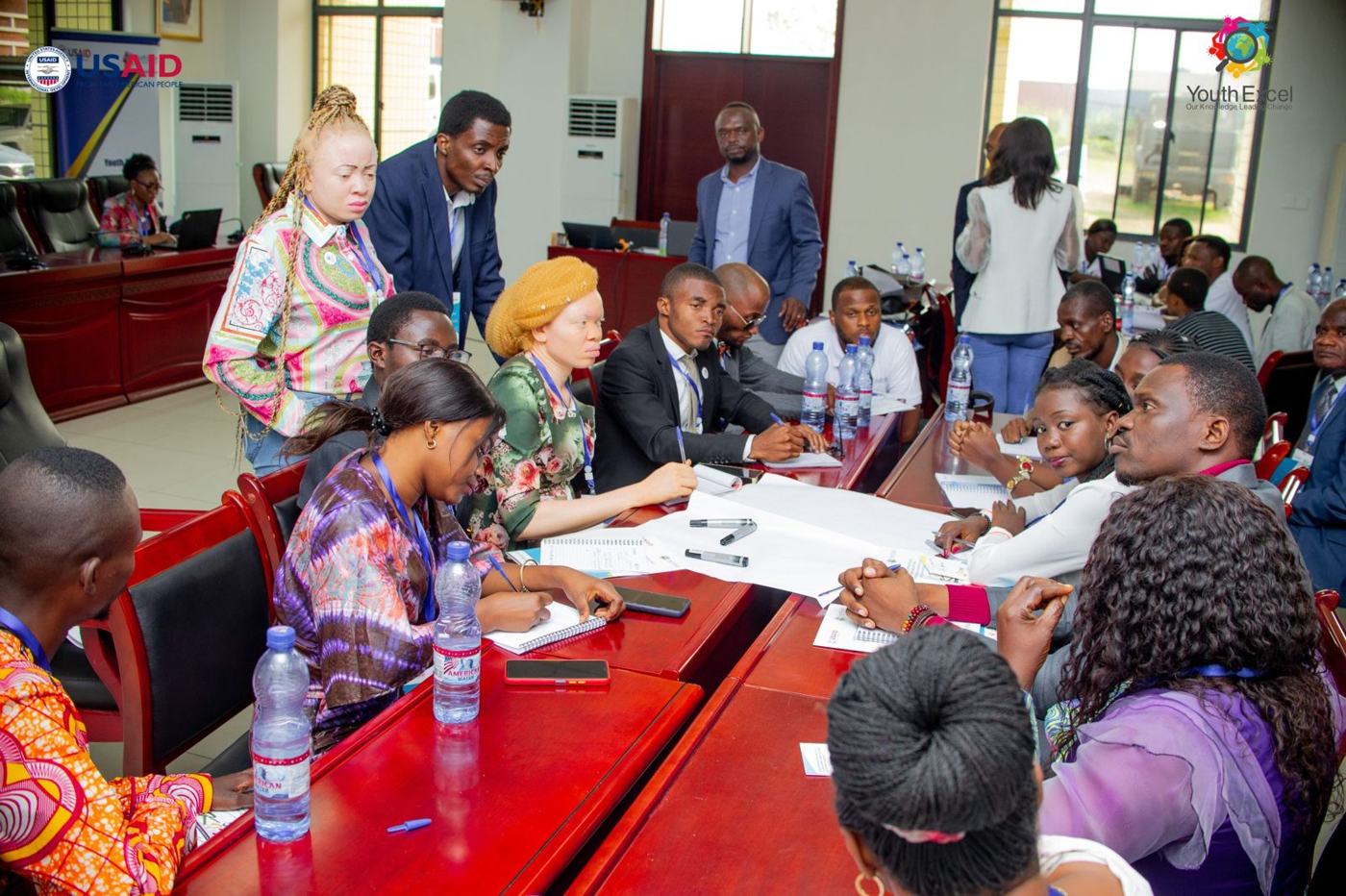
A youth researcher presents findings at the Youth Represent DRC Data Summit, Kinshasa, August 2022. Photo: CERC
Case study · Youth Excel

Case study 2 · From research to their own businesses

At the start of 2023, 45 young people in Kinshasa were out of school and out of work. By the end of the year, they were running five businesses – and training other young people in turn.

It started with young people asking questions: why are so many young people in Kinshasa left out of education and work, and what would bring them back in? The researchers of the ICON did not stop at a report. They wrote a plan of their own, chose to work together rather than alone, and took 45 young people through four steps: care first, then a trade, then a business plan, then the equipment and the microgrant to start.

Two groups now make dairy products, bread and cosmetics; two run computer centres that teach computing, design, printing and photocopying; one runs a tailoring workshop in Ngaba. Each also trains other young people.

Before (2022)After (December 2023)
45 young people out of school and out of work, some needing psycho-social care or detoxification.The 45 young people work in five businesses they run themselves.
No trade, no equipment, no capital to start an activity.Trained in a trade and in entrepreneurship; each group has its equipment, a business plan and a microgrant.
Youth organisations working separately, each on its own projects.Nine organisations ran one joint plan and five shared businesses.
Young people of different backgrounds, genders and sexual orientations rarely working side by side.They worked together, and their mutual acceptance grew, as their testimonies show.
Young people as recipients of programmes.Young people as researchers, trainers and entrepreneurs: ICON members led leadership and entrepreneurship training, and one organisation lent its office for computer classes.

The full story: “From research to their own businesses: how 45 young people in Kinshasa became entrepreneurs” (cerc.cd, 5 January 2024).

9
EduCheck and GovCheck

Technology that gives citizens a voice

In 2023, CERC developed GovCheck, a web and mobile application with which citizens document and report the irregularities they see in infrastructure projects – misappropriation of funds, corruption, poor construction quality – and send evidence, geolocated and in real time, to funders and government.

In schools, Integrity Club members used EduCheck to report school problems and the fixes they obtained, giving education officials reliable, real-time data for each school. Alongside the technology, training workshops, community meetings and awareness campaigns helped citizens know their rights and advocate effectively.

10
Special consultative status with ECOSOC since 2021

CERC at the United Nations

December 2023Tenth Conference of the States Parties to the UNCAC

CERC Representatives Mr Musa Nzamu (Programme Manager) and Heri Bitamala (CEO) attended the Tenth CoSP virtually, held in Atlanta, United States, from 11 to 15 December 2023. Their contributions focused on the nexus between corruption, financing crime and conflict in Eastern Congo, and on strategies to mitigate these challenges.

11

Part 2 · Funds statements

Where the money came from in 2023, how it was spent, and how it is accounted for.

12
2023 financial year – Education Out Loud audited by DWAC

Financial review

This financial review covers the 2023 financial year. It is based on CERC’s financial reports to its donors: the 2023 financial report of the Education Out Loud project and the reports to IREX for Youth Excel. Project accounts are kept in US dollars, on a cash basis. The 2023 accounts of Education Out Loud were audited by DWAC (CERC’s statement; the audit report is not yet published). The Youth Excel figures have not been audited.

By projectFunding in 2023

  • Students Acting for Accountability and Quality of Education (Global Partnership for Education, through Education Out Loud and Oxfam IBIS) – CERC received US$68,816 in January 2023, on top of the US$88,771 brought forward from 2022, and spent US$157,587 on the project in 2023.
  • Youth Excel (USAID, through IREX) – Phase 1 closed in February 2023 with the final balance of the award, US$6,746.05. Phase 2 was funded by the second instalment of US$71,169.16, from which each of the five economic interest groups received a US$10,000 microgrant.

All projectsConsolidated statement – all projects

Income, expenditure and balances of all projects combined, for 2023 compared with 2022. The 2023 expenditure of the Education Out Loud project is available in three categories only, so the comparison uses these three categories.

Income and expenditure2023
US$
2022
US$
Income received
GPE / Oxfam IBIS – Education Out Loud68,816.00361,361.00
USAID / IREX – Youth Excel, Phase 16,746.0558,275.15
USAID / IREX – Youth Excel, Phase 271,169.16–
Total income received146,731.21419,636.15
Expenditure, all projects combined
Programme activities155,166.96168,350.36
Direct project support (staff, travel and running costs)54,986.82152,081.80
Administration, audit and bank charges23,413.7025,386.29
Total expenditure233,567.48345,817.45
Income less expenditure−86,836.2773,818.70
Balance brought forward from the previous year86,836.2713,013.07
Adjustments (see the statement of funds)–4.50
Balance carried forward to the next year0.0086,836.27

Statement of funds, by grant

For each grant: the balance brought forward, the funds received, the funds spent, the funds returned or transferred, and the balance carried forward. A negative balance means spending ahead of funding.

Grant and donorBrought forward
US$
Received
US$
Spent
US$
Returned, transfers
US$
Carried forward
US$
2023
Youth Excel – Phase 1 (2021–2022)
USAID, through IREX · Not audited – Final IREX disbursement; December 2022 financial report to IREX, approved by IREX
−1,934.736,746.054,811.32––
Youth Excel – Phase 2: microgrants to youth micro-enterprises (2023)
USAID, through IREX · Not audited – Second instalment of the sub-award (USAspending.gov report) and CERC’s statement of expenditure
–71,169.1671,169.16––
Students Acting for Accountability and Quality of Education
Global Partnership for Education, through Oxfam IBIS · Audited – 2023 audit of Education Out Loud (DWAC; CERC’s statement)
88,771.0068,816.00157,587.00––
Total 202386,836.27146,731.21233,567.48––

Restricted fundsFunded projects

All of CERC’s income in 2023 was restricted to projects.

ProjectDonorReceived inFunds received
US$
Students Acting for Accountability and Quality of EducationGlobal Partnership for Education, through Education Out Loud (Oxfam IBIS)Jan 202368,816
Youth Excel – Phase 1, final balance of the awardUSAID, through IREXFeb 20236,746
Youth Excel – Phase 2, microgrants to youth micro-enterprisesUSAID, through IREXFeb 202371,169

Only the funds actually received in 2023 are shown. The balance of US$88,771 carried forward from 2022 on the Education Out Loud project had been received in 2022.

IncomeIncome

In 2023, the income of the Education Out Loud project amounted to US$157,587: the balance carried forward from 2022 (US$88,771), as shown in the project’s 2022 audit, and the instalment received in January 2023 (US$68,816).

In February 2023, CERC received from IREX the balance of the Youth Excel award, US$6,746.05, approved by IREX on 7 February 2023 with the December 2022 report; the project closed on 28 February 2023 after a one-month no-cost extension. With it, IREX disbursed the second instalment of the sub-award, US$71,169.16, for Phase 2, all spent in 2023: microgrants of US$50,000 to the 5 economic interest groups, staff fringe benefits (US$4,758.48), per diem of field staff (US$8,000), rent and office internet (US$1,968) and indirect costs (US$6,442.68). CERC costs – staff fringe benefits (US$4,758.48), per diem of field staff (US$8,000), rent (US$900), office internet (US$1,068) and indirect costs (US$6,442.68), US$21,169.16 in all – kept CERC at the young people’s side throughout 2023, including the 10 months of online mentoring, as they implemented their impact projects. In all, Youth Excel received US$168,697.07 from USAID through IREX; it closes at zero.

ExpenditureExpenditure

In 2023, CERC spent US$157,587 on the Education Out Loud project, in line with the expenditure forecasts: 65% on the four project objectives – including US$72,101.53 on the Integrity Clubs and their monitoring –, 25% on direct project support and 10% on administration, audit and bank charges (note 1).

Funding policyOur sources of funding

CERC is funded by institutional donors, directly or through partner organisations, through grants restricted to projects. Each project has its approved budget; CERC reports to its donors through narrative and financial reports with supporting documents, and project accounts are audited as each donor requires.

Note 1Education Out Loud project – income and expenditure 2023

ItemUS$
Income
Balance carried forward from 202288,771.00
Instalment received in January 202368,816.00
Total income 2023157,587.00
Expenditure
Category 1 – the four project objectives101,836.96
– objective 1: high-level advocacy and policy engagement5,836.22
– objective 2: Integrity Clubs and monitoring72,101.53
– objective 3: training of teachers and principals, Education Clusters15,995.72
– objective 4: student-led advocacy and campaigns7,903.49
Category 2 – direct project support39,216.41
Category 3 – administration, audit and bank charges16,533.63
Total expenditure 2023157,587.00
13

Our partners

CERC thanks the partners who made this work possible in 2023: the Global Partnership for Education and Oxfam IBIS through Education Out Loud, USAID and IREX through Youth Excel, Search for Common Ground, the nine youth organisations of the ICON consortium, APNAC DRC, the education authorities of South Kivu and Kinshasa, Radio Maria and Radio Maendeleo, and the students, teachers, parents and school leaders of the Integrity Clubs.

Global Partnership for EducationOxfamMinistry of Education