SHINE Project Evaluation – Year One 2017–2018

October 2017 – September 2018: 300 students trained to monitor their schools in 20 Integrity Clubs in Uvira. A relevant, effective and efficient project – but still too small.

Translated from the original French edition.

Download the report (PDF)

1

The evaluation at a glance

A relevant, effective and efficient project, managed in a professional and transparent way – but still on too small a scale.

300

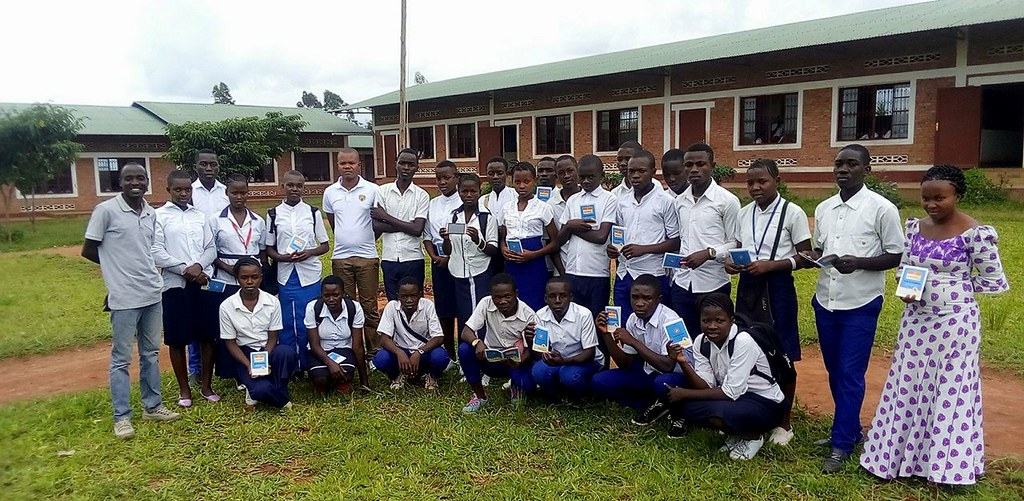
monitors aged 15 to 19 trained, 152 of them girls, in 20 Integrity Clubs

1,623

young people in other schools reached by club members

41

services and infrastructure projects monitored: 20 services, 21 projects

43%

impact measured by the Fix Score among young people, against a 15% target

2

Summary

In October 2018, CERC evaluated the first year of its first project: 20 Integrity Clubs in secondary schools in Uvira territory.

Students Acting for Honesty, Integrity and Equality (SHINE) ran from 1 October 2017 to 30 September 2018 in 20 secondary schools in Uvira territory, South Kivu, with a budget of £50,000, funded by NORAD and Sida through Integrity Action.

The internal evaluation assessed the project against World Bank evaluation criteria, adapted to CERC’s own. It draws on the project documents, a field mission from 15 September to 4 October 2018, and a survey of club members at the start and end of the year.

FindingsWhat the evaluation says

  • Relevant: the project met an acute need for integrity in education, but its critical mass – 20 of Uvira’s 303 secondary schools – was low.
  • Effective: the planned activities and results were achieved, and training was of high quality.
  • Efficient: the budget was kept, at US$184 per person trained and US$1,609 per service or project monitored.
  • A clear impact on attitudes: 93% of students know how to monitor a public project or service, up from 55%; only 11% would give a teacher a gift, down from 64%.
  • Elements of sustainability, to be strengthened by an exit strategy in partner schools.

“Project management was professional and transparent.”

3

Assessment against the evaluation criteria

The results of the evaluation, criterion by criterion.

CriterionEvaluation questionRatingMain findings
RelevanceDid the project’s objectives meet the needs of building integrity in its context?SatisfactoryAn acute need for integrity in education, confirmed by students and head teachers; low critical mass (20 schools) and clubs that rely on volunteering.
EffectivenessTo what extent were the objectives achieved?SatisfactoryActivities and results achieved; quality training with detailed manuals; project monitoring and dialogue carried out as planned and relayed on radio. Results framed in very general terms.
EfficiencyWere the results worth the money spent?SatisfactoryBudget kept, minimal reallocations, full reports to Integrity Action; US$184 per person trained, US$1,609 per service or project monitored.
ImpactDid the project change attitudes and behaviour?Moderately satisfactoryA clear impact on students’ knowledge and attitudes; a multiplier effect on more than 1,600 students in other schools. Data still partial.
SustainabilityWill the effects last after funding ends?Moderately satisfactoryTrained facilitators, teaching manuals and clubs with elected representatives; no explicit exit strategy yet.

Ratings taken from the conclusions of the internal evaluation report of October 2018.

4
Integrity Action · NORAD · Sida

The project and its context

SHINE responded to the lack of transparency and poor service delivery in the DRC, which the project put down first to the lack of a culture of integrity.

ContextSchools that lack everything

The DRC’s vast natural wealth does not translate into better development for its citizens. Decades of war have devastated school infrastructure. Free education is a constitutional right, but the education system is largely funded by parents; most schools fall short of minimum standards: overcrowded classes without equipment, sanitation, running water or teaching materials, and underpaid staff.

Because young people have little power or influence in education, CERC chose to build strong links between service users and providers – the State, faith-based bodies, head teachers and teachers – and to make gender a tool for fair and inclusive participation.

DiagnosisThe symptoms of corruption seen by communities

  • Young students lack a culture of integrity and ethics.
  • Poverty is a main root of corruption and of the lack of engagement.
  • Education authorities and contractors lack transparency and manage poorly.
  • Schools demand undue fees and mismanage education resources.
  • Service providers and project implementers do not feel accountable.
  • Communities do not know how schools work or how to influence them.

ObjectivesFour expected results for year one

  1. CERC builds anti-corruption measures into the education sector, directly benefiting 300 young monitors.
  2. 300 engaged and supported young monitors aged 14 to 19 are active agents of change.
  3. Secondary schools take up Integrity Clubs to make the effort last.
  4. An exemplary success attracts wider support and demand for anti-corruption measures in education.

ImplementationClubs, community monitoring and dialogue

Each result had a priority action: Integrity Clubs and training facilitators in community integrity building; community monitoring of schools’ education services and of ongoing projects in communities; and dialogue with providers, local authorities and implementers, through joint discussion groups, radio debates and advocacy campaigns.

5

Logical framework: targets and results

Year one indicators, from target to result achieved.

IndicatorTargetResult achieved
Secondary school monitors (aged 15 to 19)300300, of whom 152 girls and 148 boys
Young people still active in the clubs at the end of the project300277
Girls among club members50%52%
Girls among club leaders30% (40% in the project document)48%
Members from groups at risk of exclusion15%4.6% (14 young people)
Integrity Clubs set up and running2020, of which 19 active at the end
Young people reached by the clubs2,0001,623, of whom 61 from groups at risk of exclusion
Impact measured by the Fix Score among young people reached15%43%

The only target missed is the share of members from groups at risk of exclusion: 4.6% against a 15% target.

6
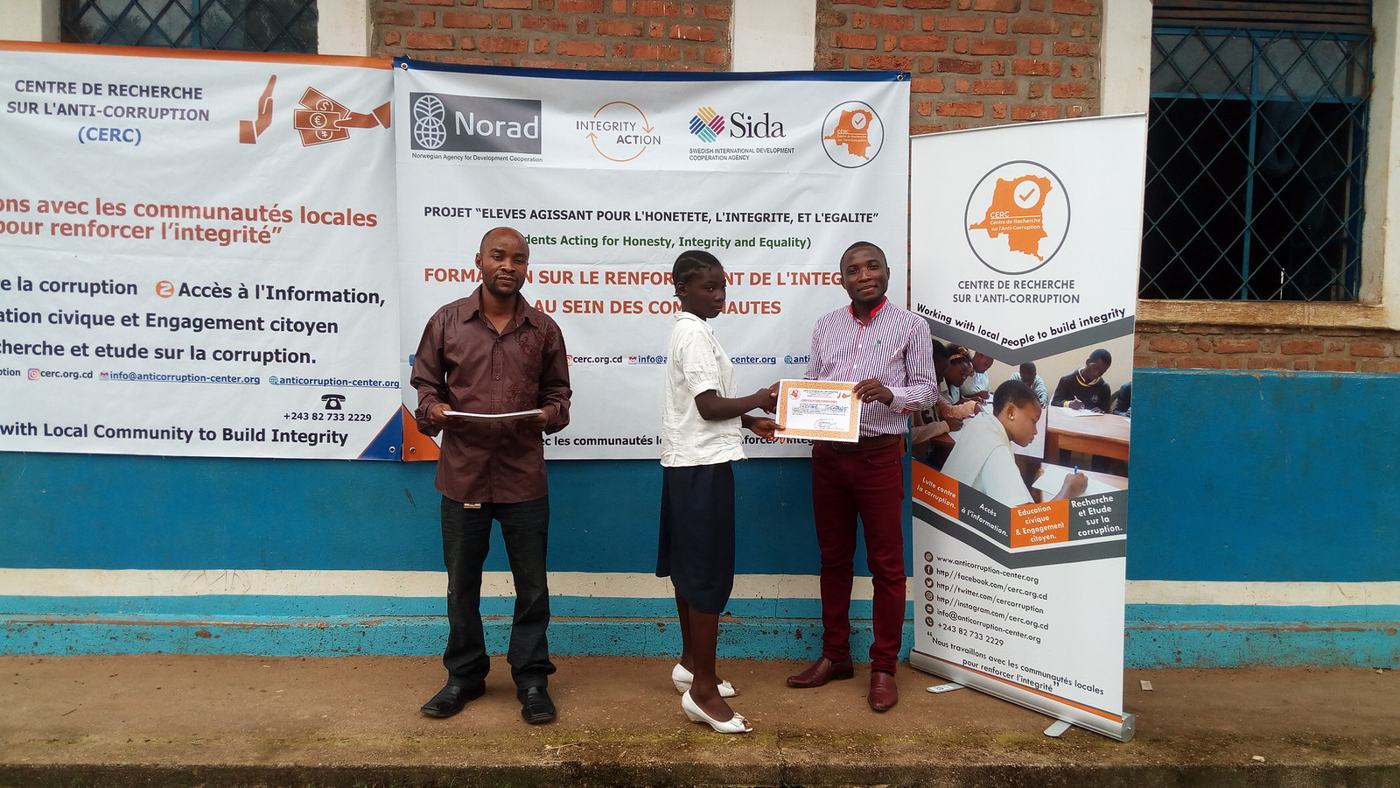
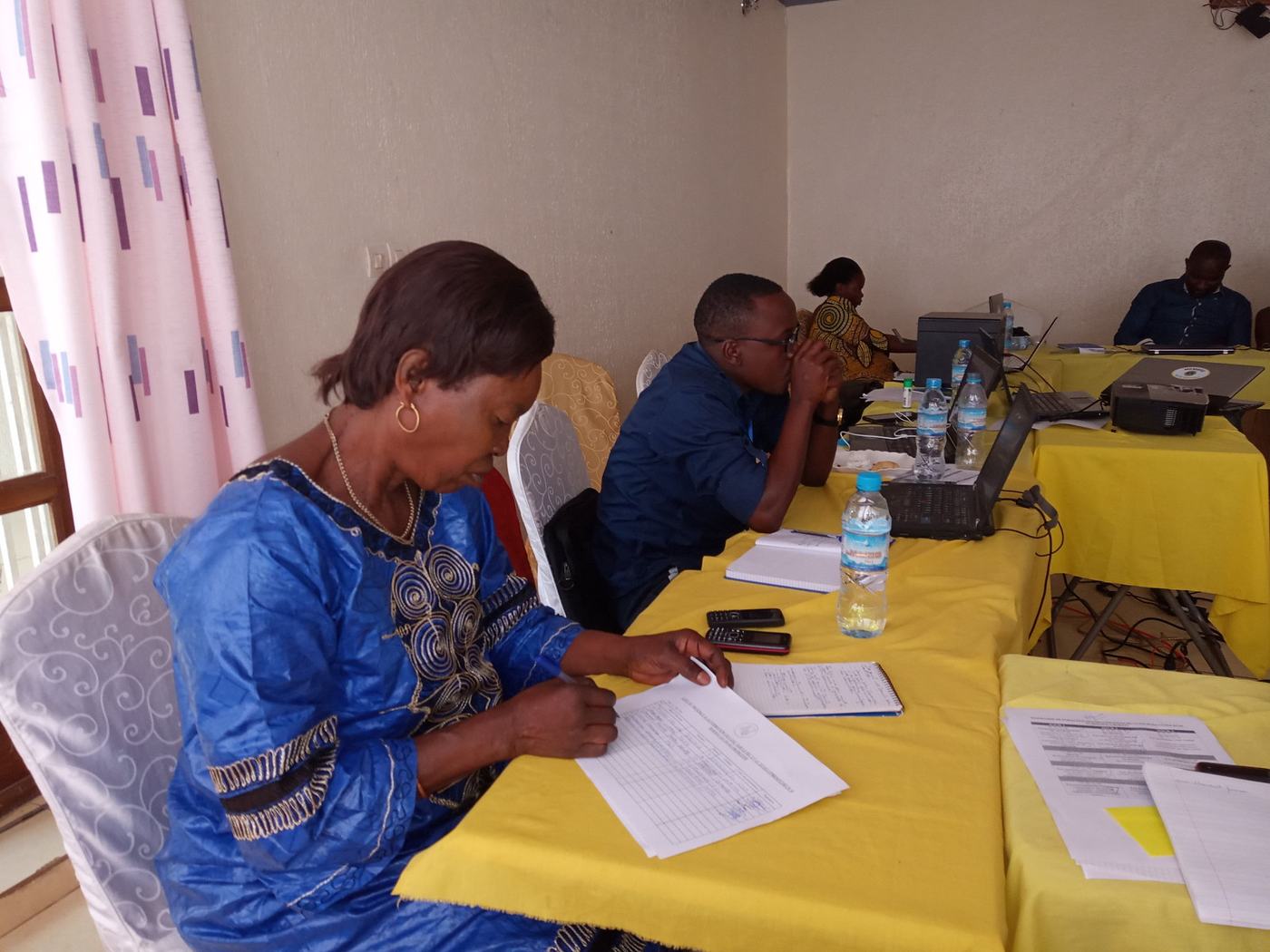
Training of Integrity Club leaders, Uvira, 2018
15 September – 4 October 2018

Purpose and methodology

To understand what makes a project successful, to inform CERC’s future strategies in education – and to check that the expected results were achieved.

Terms of referenceWhy evaluate

Under its terms of reference, the evaluation was to “carry out an in-depth analysis of the project’s implementation in order to better understand what makes a successful project” and help CERC set its future strategies for promoting transparency and integrity in education in the DRC.

TeamAn internal evaluation

The evaluation was led by Douce Kanyeba Songolo, Monitoring, Evaluation and Learning Officer, and Heri Bitamala, Programme Officer, who wrote the report.

ApproachDocuments, field work, survey

  • Document review: project document and results framework, mid-term report, final narrative and financial reports, budget, monitoring and evaluation tool, Integrity Action’s Integrity Clubs guide.
  • Field mission from 15 September to 4 October 2018, based on a matrix of themes: project coordinators, club members, teachers and head teachers, community members, workers on the projects monitored.
  • Baseline and endline surveys of club members on their knowledge and attitudes.

CriteriaWorld Bank criteria

The evaluation questions follow World Bank criteria, adapted to CERC’s: relevance, effectiveness, efficiency, impact, sustainability and CERC’s added value (annex 1).

7
Criterion 1

Relevance

The project was unquestionably relevant: it met an acute need to build integrity and fight corruption in education.

The project’s diagnosis was sound: many young people struggle to access education, and government, providers and implementing agencies are not truly accountable to citizens. Club members and head teachers interviewed confirmed “the poor state of school infrastructure, mismanagement, young people’s exclusion from decision-making and the lack of accountability”.

LimitationLow critical mass

The project reached only 20 of the 1,478 schools identified in South Kivu, and of the 303 secondary schools in Uvira territory: on its own, it could not build a culture of integrity across its area.

LimitationClubs that rely on volunteering

The clubs depend on their members’ voluntary commitment, while few Congolese can give much time to unpaid activities – a limit eased by the commitment of head teachers and teachers.

Rating: satisfactory. All four components were justified; the scale remained too small.

8
A DevelopmentCheck training session, 2018
Criterion 2

Effectiveness

All planned activities and results were achieved – although the results were framed in very general terms.

  • Training by experts in integrity education and community monitoring reached 57 teachers and 50 club leaders, who in turn trained 240 other club members and more than 1,600 students in other schools.
  • Participants received detailed manuals, with a part on techniques for passing knowledge on to students.
  • Project monitoring and dialogue with local leaders, providers and implementers went ahead as planned; radio programmes relayed the debates beyond what the results framework foresaw.

MonitoringWhat students monitored

In schools: class sizes, administrative and financial management, quality of supervision, materials and infrastructure, teacher performance, quality of the curriculum and relations with parents. In communities: water supply, electricity, and school construction and rehabilitation projects.

Rating: satisfactory. Results achieved; training would have gained from being repeated.

9
Criterion 3

Efficiency

Most results were achieved within the budget agreed with Integrity Action – itself an appropriate budget.

BudgetMain lines of expenditure

Budget lineUS$Share of budget
Meetings and training sessions (including training 5 staff in Tanzania)12,496.5019%
Salaries of 7 staff, 12 months20,32531%
Reimbursements to Integrity Clubs for community monitoring and advocacy9,45115%
Rent, premises and office equipment5,81010%
Printing of student and teacher manuals, publications1,5002.3%

Setting up the Integrity Clubs took only modest sums. The salaries of seven staff – a programme director, two coordinators, a monitoring and evaluation officer, a communications officer, a finance officer and an advocacy officer – stayed below the time they actually gave the project. Reallocations and overspends were minimal, and reports to Integrity Action were full and detailed.

CostPer person trained and per project monitored

US$184per person trained: 300 monitors, 38 teachers and 19 head teachers
US$1,609per service or project monitored: 20 services and 21 infrastructure projects

Efficiency was strengthened by a competent and committed team, trained by Integrity Action in Dar es Salaam, Tanzania, in November 2017, and by exchanges with other partners in the Integrity Clubs network.

Rating: satisfactory. The project made appropriate use of its resources.

10
Criterion 4

Impact

Students who know how to monitor their schools, report problems and refuse corruption: the baseline and endline surveys show a clear change.

In a qualitative project, changes cannot be attributed to the project with certainty, but their signs can be traced. Share of club members who “strongly agree” or “agree”:

StatementStartEndChange (points)
Q1. I know how to monitor a public project or service55%93%+38
Q2. I know how to make a recommendation to improve a project or service42%66%+24
Q3. I know how to use DevelopmentCheck to monitor construction projects in my community20%41%+21
Q4. I know where to report a problem I find in a public service44%76%+32
Q5. I know how to organise a group of citizens to monitor a project or service42%68%+26
Q7. Job opportunities should be the same for women and men55%90%+35
Q8. People like me can make a difference in fighting corruption59%94%+35
Q9. I would happily give my teacher a gift to improve my grade64%11%−53
Q10. An honest person has less chance of success than one willing to be corrupt at times35%39%+4
Q11. I know how to work with others to solve problems in a project or service44%93%+49

KnowledgeThe right answer chosen

QuestionStartEndChange (points)
Q12. A contractor uses poor-quality materials: “I report my suspicion to the authorities”41%93%+52
Q13. Integrity, “the qualities that make a person reliable, honest and trustworthy”51%94%+43
Q15. Democracy, “power held or controlled by the people”68%88%+20
Q16. Gender equality, “equal opportunities for women and men in all areas”30%61%+31

Trained teachers and students played their roles as facilitators and monitors better, taking communities’ concerns to providers and implementers. The knowledge shared with more than 1,600 students in other schools points to a multiplier effect.

Rating: moderately satisfactory. A clear impact on the target groups; questions 6, 14, 17 and 18, with mixed or inconsistent results, are in the annex.

11
Criterion 5

Sustainability

The project built in elements of sustainability; an explicit exit strategy would strengthen them.

  • The 38 facilitators and 59 club leaders received four days of training, and the integrity education manuals include a teaching component: they can keep training in their schools.
  • Each club has two facilitators and elected representatives: nothing stops it acting without funding. CERC’s direct support was modest – transport, communication and refreshments on field visits.

Going furtherStrengthening sustainability

  • Link the clubs to student committees and encourage other NGOs to involve them in their work.
  • Connect the clubs with NGOs that promote transparency.
  • Encourage teachers and head teachers to run training themselves.
  • Encourage the clubs to keep links with communities and local administrations, and to take on new projects together.

Rating: moderately satisfactory. Real elements of sustainability, without a formal exit strategy.

12

Conclusions

A project that achieved its results thanks to the quality of its trainers and the motivation of the CERC team.

ResultsResults achieved, schools on board

Activities and results were largely achieved, with the support of many of the head teachers and teachers targeted.

ManagementProfessional and transparent

CERC managed the project effectively, combining collegiality – consulting the whole team – with good governance.

TrainingHigh quality, but to be repeated

Relevant topics and high-level trainers; repeating the training, set aside to save money, would have better embedded what was learned.

AttitudesStudents who resist corruption

The attitudes of head teachers, teachers and students changed; the students interviewed firmly resist corruption in their schools.

LessonMonitors cannot do it alone

The work of community monitors must be complemented by civil society and the State, especially for advocacy and accountability to the population.

13

Recommendations and follow-up

The evaluation’s recommendations to CERC – and what CERC did with them.

FindingRecommendationFollow-upCriterion
The project only began an agenda for reducing corruption at local levelDevelop a project that builds on SHINE’s achievementsSHINE continued until 2020: 54 Integrity Clubs in Uvira and Bukavu, 810 students trained.Relevance, sustainability
Many civil society initiatives for transparencyStrengthen collaboration and synergies with other NGOs, including for trainingPartnerships with Accountability Lab, the UNCAC Coalition, Oxfam, IREX and RCN Justice & Démocratie.Coherence, efficiency
Low critical mass: 20 schoolsExtend the clubs beyond Uvira204 Integrity Clubs in South Kivu and Kinshasa by 2022.Relevance, impact
No explicit exit strategyPlan an exit strategy in partner schoolsThe education authorities agreed to extend the clubs across South Kivu province.Sustainability
Training not repeatedRepeat training throughout the projectFacilitators trained on the anti-corruption legal framework in 2019.Effectiveness
4.6% of members from groups at risk of exclusion, against 15% targetedReach young people at risk of exclusion betterCERC’s gender equality and social inclusion strategy, 2021.Relevance

The first two recommendations are the report’s; the others follow from its findings. The Follow-up column is taken from CERC’s reports published since.

14

Annexes

The evaluation questions, the survey’s mixed results and the documents reviewed.

Annex 1Evaluation questions

Relevance: were the objectives consistent with the needs and priorities of building integrity? are they still valid? does the project meet stakeholders’ expectations? would another strategy have worked better? were risks identified and addressed?

Effectiveness: to what extent were the objectives achieved? what were the outputs? why were any results missed?

Impact: did the project affect the problem it set out to solve, have tangible effects on beneficiaries, bring planned or unplanned change? can it have a catalytic effect?

Efficiency: was the clubs’ budget reasonable? were results worth the spending? were partnership requirements met?

Sustainability: will processes extend the impact after funding? do stakeholders want to continue?

CERC’s added value: did CERC achieve results the clubs could not have achieved alone?

Annex 2Mixed survey results

Q6. “I know how to collect evidence on a serious problem”: 73% agree at the end of the year; the published baseline is inconsistent (it totals more than 100%).

Q14. Social audit: the answer “all of the above” rises from 12% to 47%.

Q17. The legal provisions on corruption: scattered answers with no clear progress.

Q18. An example of corruption: “reporting a teacher who asks for a gift” chosen by 58% at the end, up from 50%, and “cheating in an exam” by 13%, up from 2% – a misunderstood question.

Annex 3Documents reviewed

Integrity Clubs user guide (Integrity Action); results framework; project document; monitoring and evaluation tool; mid-term report; final narrative report; project budget; final financial report.

AcknowledgementsThank you

CERC thanks Douce Kanyeba Songolo for organising the evaluation, project coordinators Evariste Loketo and Bernardin Bitundwa Ruhindisha, and everyone we met, especially the facilitators and members of the Integrity Clubs.

Integrity Action