The Integrity Builder (Les Bâtisseurs de l’intégrité)
Your quarterly magazine on transparency, access to information and the promotion of integrity.
CERC joins the Coalition for the implementation of the UNCAC, is received at the Ministry of Justice and is recommended for special consultative status with ECOSOC.
CERC becomes a member of the Coalition for the implementation of the United Nations Convention against Corruption
A CERC workshop on fighting corruption. Photo: CERC
CERC is proud to become an ordinary member of the Coalition for the implementation of the United Nations Convention against Corruption (UNCAC Coalition), a coalition of more than 350 civil society organisations in more than 100 countries around the world, committed to promoting and implementing the Convention.
The United Nations Convention against Corruption is the first global instrument against corruption, organised crime and economic crime, including money laundering. It contains, among other things, provisions on preventing corruption, rules organising international cooperation and procedural standards.
With this membership, the Centre de Recherche sur l’Anti-Corruption will contribute to the implementation of the Convention in the Democratic Republic of the Congo.
02Advocacy
CERC’s director received at the Ministry of Justice to discuss civil society participation in the UNCAC review process
At the Ministry of Justice, 14 May 2021. Photo: CERC
On Friday 14 May 2021, the Executive Director of the Centre de Recherche sur l’Anti-Corruption, Mr Heri Bitamala, and his executive assistant for advocacy and policy engagement, Maître Musa Nzamu Jonathan, met Maître Fidèle Mawete Fakana, the DRC’s representative in the review process of the implementation of the UNCAC.
Several points were at the heart of this meeting, which lasted several hours, in particular the DRC’s implementation of the UNCAC and civil society participation in the review process in the Democratic Republic of the Congo.
Articles 5 and 13 of the UNCAC particularly stress the importance of civil society participation in the fight against corruption. Accordingly, as an ordinary member of the Coalition for the implementation of the UNCAC since 2020, CERC was appointed by the Coalition to produce the parallel report on the application of the UNCAC by the Democratic Republic of the Congo.
The United Nations Convention against Corruption, which entered into force on 14 December 2005 and was ratified by the DRC on 23 September 2010, is the most comprehensive and most respected global convention against corruption. It obliges States Parties to implement a wide range of detailed anti-corruption measures affecting laws, institutions and practices, including international cooperation. It gives governments an excellent frame of reference for measuring their progress against corruption and a springboard for their reform agenda.
03United Nations
The Committee on NGOs recommends special consultative status for the Centre de Recherche sur l’Anti-Corruption
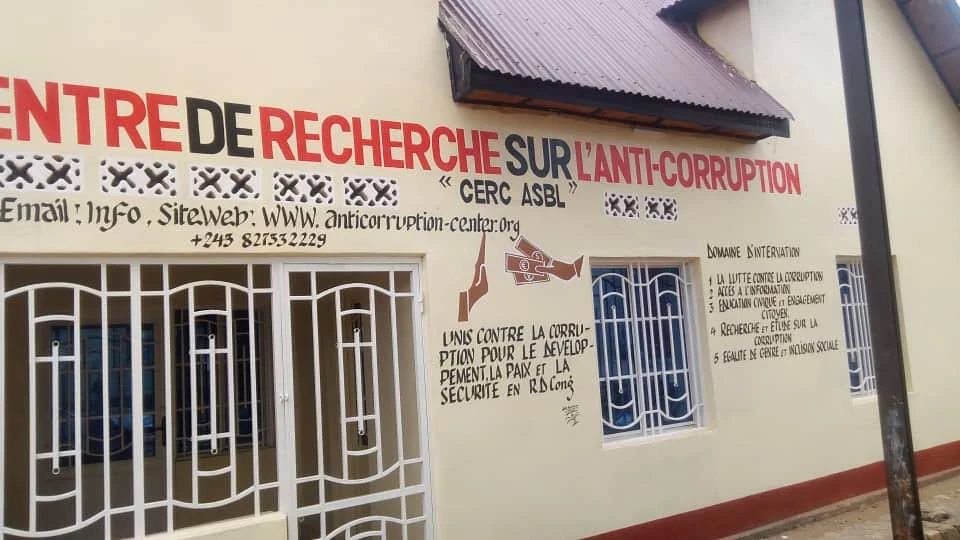
The office of the Centre de Recherche sur l’Anti-Corruption, 2021. Photo: CERC
The Committee on NGOs opened its 2021 session on 17 May 2021 by recommending that the Economic and Social Council (ECOSOC) grant special consultative status to the Centre de Recherche sur l’Anti-Corruption.
The Committee, made up of 19 members, examines the applications submitted by non-governmental organisations and grants them, depending on their mandate, their management and their financial regime, general consultative status, special consultative status or inclusion on the roster.
Special consultative status gives CERC access not only to the Council’s meetings, but also to its many subsidiary bodies, to the various United Nations human rights mechanisms and to the special events organised by the President of the General Assembly.
Heri Bitamala adds that, with four years’ experience in fighting corruption, CERC will be able to offer its expertise to the Council and its subsidiary bodies. ECOSOC is one of the principal organs of the UN responsible for coordinating and making recommendations on economic, social and environmental issues, and on the implementation of internationally agreed development goals.
“This is a great achievement for the Centre de Recherche sur l’Anti-Corruption and for our work with communities affected by corruption. With special consultative status, we can influence decision-making at the highest level.”
Centre de Recherche sur l’Anti-Corruption (CERC) · info@cerc.cd · www.cerc.cd
CERC is a Congolese non-governmental organisation with special consultative status with the United Nations Economic and Social Council (ECOSOC) since 2021.
Exaucée
CERC’s assistant
Hello, I’m Exaucée, CERC’s assistant. How can I help you?
You can write your question, we will reply instantly.
Do not share personal information here. To report a case of corruption, use the whistleblowing page: it protects you.
CERC citizen monitoring apps
Help improve public services
Report what you see in your school or health centre. Your feedback helps make education and health services in the DRC better and more transparent.