
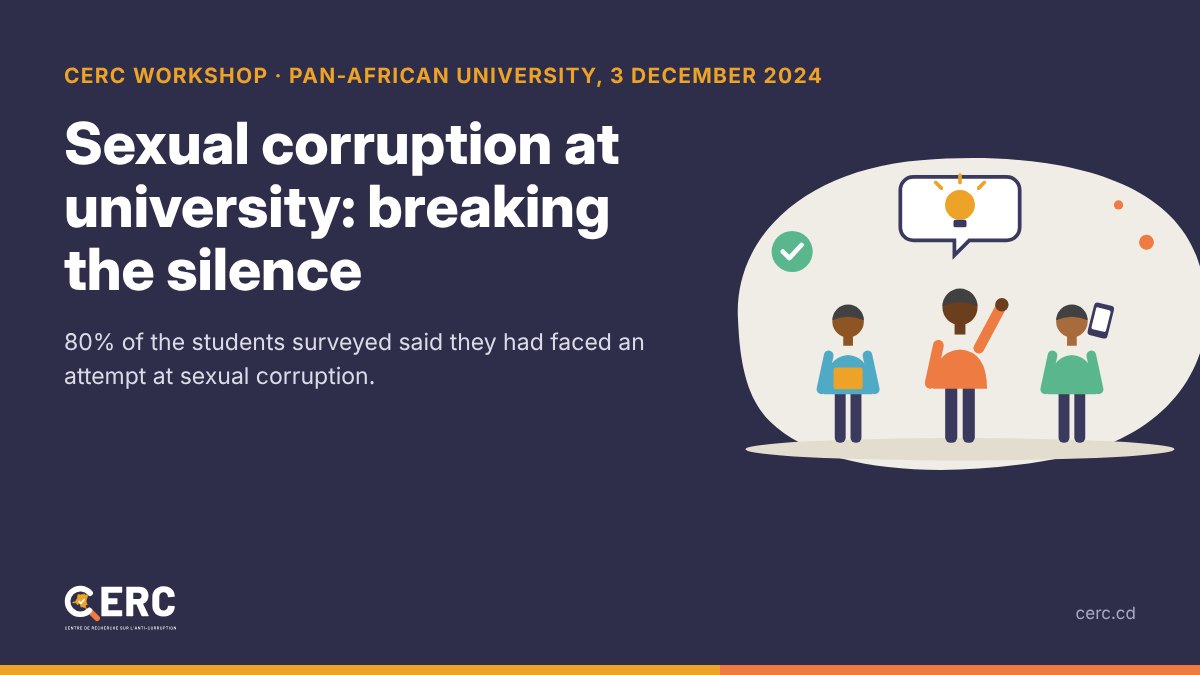
Kinshasa, 3 December 2024 – In some public and private universities in Kinshasa, female students face sexual corruption. The practice, which combines abuse of power and exploitation, seriously harms the future of women in the Democratic Republic of the Congo.
Vulnerable and often powerless in the face of lecturers ready to abuse their position, female students are sometimes forced to grant sexual favours in exchange for good marks. Far from being isolated, this has disastrous consequences for their academic and professional ambitions.
At a workshop held on 3 December 2024 at the Pan-African University by the Centre de Recherche sur l’Anti-Corruption (CERC), with support from RCN Justice & Démocratie, students from four universities in Kinshasa shared their experiences.
Powerful testimonies
“We students face huge challenges, including sexual corruption. As a class representative, I receive reports of cases where girls are used as a bargaining chip to pass. It often happens when female students find themselves in a vulnerable position.”
Myrian, class representative and member of an inter-university club
“[…] We also see practices such as ‘sexually transmitted marks’, and female students forced to give [their bodies] to get marks.”
Deborah, law student
An invisible and rarely reported problem
“This sexual side of corruption in universities, although common, is rarely discussed in the DRC. It is hard to identify and deal with, because it is neither reported nor followed by complaints. That is because Congolese criminal law punishes both the person who offers the bribe and the person who takes it. For fear of being convicted themselves or stigmatised, victims prefer to stay silent.”
Jonathan Musa Nzamu, CERC’s Regional Director for Kinshasa and Kongo Central
At the workshop, 80% of the students surveyed said they had faced an attempt at sexual corruption, often in the form of propositions or blackmail by some academic staff. Men are not spared either: cases of sexual corruption targeting them are nicknamed “2x2x”.
Solutions in the making
To fight this scourge, CERC is preparing an action plan with an inter-university student network, to:
- inform victims of their rights and raise awareness;
- encourage women to report sexual corruption;
- break the silence around this offence.
A call to reform the law
CERC calls for an overhaul of the legal framework to punish these practices, which are an abuse of power, and to protect the victims who report them instead of exposing them to prosecution. The fight for an ethical and respectful university environment must involve all sections of society, because education remains the foundation of a better future for the DRC.
The REPLIC project with RCN Justice & Démocratie
This activity is part of the REPLIC project – Agir pour une justice redevable, plurielle et intègre au Congo (acting for accountable, plural and honest justice in the Congo), run by CERC in 2024 with RCN Justice & Démocratie under the second Justice Reform Support Programme (PARJ II), funded by the European Union and the Belgian Development Cooperation (DGD).
- The REPLIC project in our projects: aims, results and funding
- REPLIC project report 2024: the social alert system in the courts and the university integrity clubs
- RCN Justice & Démocratie among our partners
A first version of this article was written in French by Hornela Mumbela and published by Habari RDC on 19 December 2024.