

 Feature storyCase study: how DigitalOcean’s cloud credits keep citizen monitoring online in the DRC
Press releaseBy CERC
Conflict gold now funds the ISIL-affiliated ADF in the DRC
The ISIL-affiliated ADF has become a largely self-reliant insurgency funded by conflict gold trafficked to Uganda – an estimated $1 million to $1.6 million a year from the Manguredjipa mines. What it means for accountability and peace in eastern DRC.
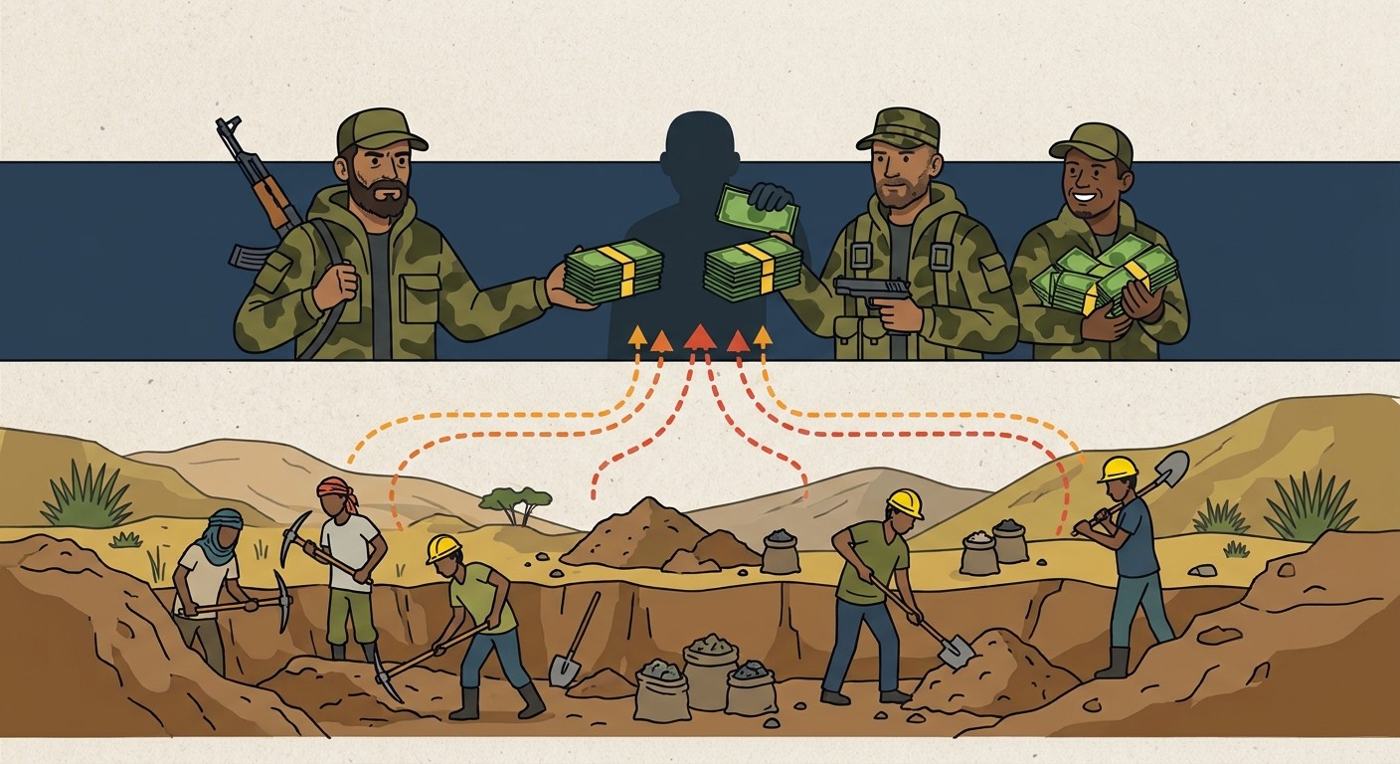
Kinshasa, 27 October 2026 – The Allied Democratic Forces (ADF), an affiliate of the Islamic State (ISIL) that the United States designates a foreign terrorist organisation, no longer depends on money sent from abroad. A new investigation into the group’s finances shows that it has become a largely self-reliant insurgency, funded above all by conflict gold dug in eastern Congo and trafficked to Uganda. For CERC, this is not only a security story. It is a corruption story, and it runs straight through the mines, the traders and the banks that turn Congolese gold into cash.
An insurgency that pays for itself
The shift matters because it changes what keeps the war going. The ADF once leaned on transfers linked to ISIL; today it largely pays for itself. The gold mines it controls around Manguredjipa alone are estimated to generate US$1 million to US$1.6 million a year, with cocoa, racketeering and kidnapping supplying the rest. An armed group that finances its own violence does not wait for a sponsor’s permission to keep killing – which is why cutting the money matters as much as the fighting.
The cost to civilians is already measurable. In 2025, the Armed Conflict Location & Event Data project (ACLED) ranked the ADF the second deadliest non-state armed group in the world. As of February 2026 it counted an estimated 600 to 700 combatants – a number it sustains by force, abducting people, including children as young as nine, to fill its ranks.
Military pressure has moved the problem rather than solved it. A joint operation with the Ugandan army, which keeps several thousand troops in eastern DRC, has pushed the ADF towards the areas richest in gold and cocoa – closer to the very resources that keep it alive. Displacing an armed group onto its own funding is not a defeat; it is a relocation.
“Illicit gold is now the chief source of financing for the ISIL-affiliated terrorist group in the DRC.”
Sasha Lezhnev, Senior Policy Advisor, The Sentry
“Conflict gold continues to flow to Uganda from ADF-held areas.”
John Prendergast, Co-founder, The Sentry
Where the chain can be broken
The recommendations point less at the forest than at the market that pays for what comes out of it:
- the UN Security Council, the US, the UK and the EU should investigate the conflict gold supply chains linking eastern DRC to Ugandan trading, refining and export networks;
- Uganda should keep its army deployments within its existing agreements with the DRC and stop unilaterally expanding the operation’s geographic scope;
- the DRC should rebalance its security priorities to counter the ADF as well as the M23, with dedicated deployments and coordinated operations on both fronts;
- international partners should help the DRC build long-term civilian strategies to reduce the ADF’s local entrenchment and recruitment base, since military pressure alone has so far displaced the group rather than dismantled it.
The gold and financial industries, for their part, should treat Uganda and the United Arab Emirates as high-risk for illicit gold and apply enhanced due diligence to transactions involving them.
How this connects to CERC’s work
These findings sit squarely within CERC’s work on natural resources and public money. We have shown how 1,600 companies mining illegally in South Kivu feed a war economy that accountability in the mining sector could help end, and we have asked what monitoring mechanisms the US–DRC strategic-minerals partnership will need if it is not to become another channel for corruption. The thread is the same one we follow from school budgets to court files, and from the illicit financing of political parties to the mine: corruption is the diversion of value away from the people it belongs to, and it is traceable. The combatant in the forest is hard to reach; the refinery, the exporter and the bank that clears the payment are not.
It is also why the same method we use in schools and health centres – citizen monitoring and “follow-the-money” research, turned into evidence for the people with power to act – belongs on the resource chains that finance armed groups. As long as gold mined in conflict zones finds buyers, refiners and banks, violence against civilians stays profitable, and the revenues that should rebuild the east leak away instead.
In our 2027–2030 strategy
This is why conflict gold belongs in CERC’s 2027–2030 strategy to rebuild eastern Congo with integrity. That strategy treats the war economy and the public purse as one problem. Over 2027–2030 we will extend citizen monitoring and follow-the-money research from classrooms and clinics to the resource chains behind the conflict, press for the traceable supply chains and investigations this report calls for, and keep putting the evidence in front of the governments, donors and justice institutions that can act on it. A traceable supply chain is not a technical footnote to peace in eastern DRC – it is one of its conditions.
Note. This article draws on the investigation by The Sentry, “New Report: ISIL Affiliate in the DR Congo Has Evolved into a Self-Reliant Insurgency Sustained by Conflict Gold” (Washington, 27 October 2026), and the report Gold-Backed Brutality: The ISIL-affiliated Allied Democratic Forces in the Democratic Republic of the Congo, which draws on more than 100 interviews. The quotations are those of Sasha Lezhnev and John Prendergast, of The Sentry.
About CERC
The Centre de Recherche sur l’Anti-Corruption (CERC) is a Congolese non-governmental organisation founded in April 2017 in South Kivu. With young people at its heart, CERC works with schools, communities, public institutions and partners to promote transparency, accountability and integrity in the Democratic Republic of the Congo. It has held special consultative status with the United Nations Economic and Social Council (ECOSOC) since 2021. Learn more: Who we are.
Feature storyCase study: how DigitalOcean’s cloud credits keep citizen monitoring online in the DRC Feature storyFighting Corruption in Schools: CERC and APNAC DRC to propose Legislative Initiative to the National Assembly of the DRC
 Press releaseSASA: the US$6.5 million scale-up swept away by the closure of USAID
 Press releaseEbola: Africa CDC demands accountability for more than US$700 million


