
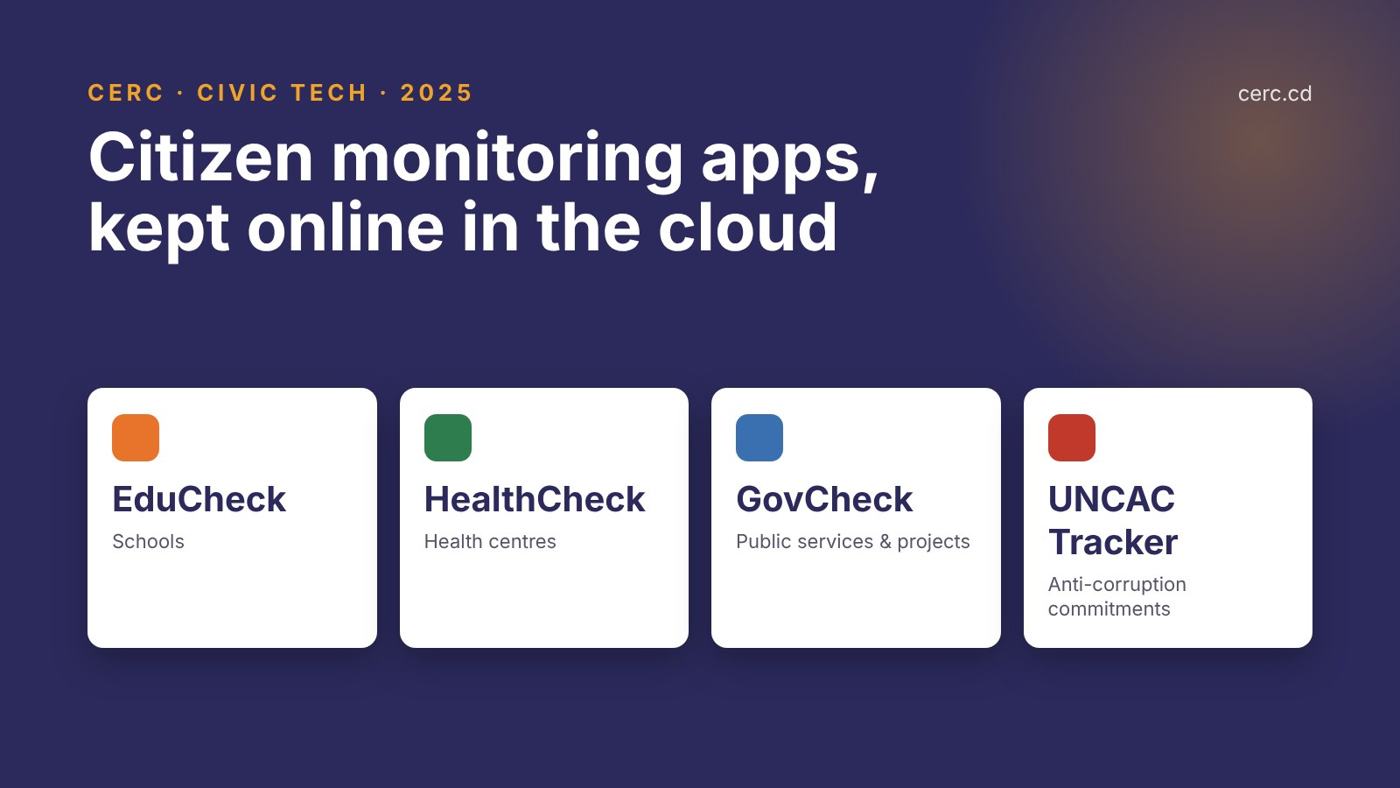
Kinshasa, 15 October 2026 – In 2025, DigitalOcean supported the Centre de Recherche sur l’Anti-Corruption (CERC) with non-profit cloud credits worth about US$2,000. These credits host all four of CERC’s civic tech apps – EduCheck, GovCheck, HealthCheck and UNCAC Tracker. This case study explains what this support made possible, why these tools matter in the Democratic Republic of the Congo, and what other donors can do.
The context: corruption, governance and insecurity
In the DRC, corruption is felt first in public services: unofficial fees at school and in health centres, missing medicines, school grants and building works that do not reach the pupils they are meant for. Decision-makers rarely receive verified information from the ground, and citizens who report problems can face reprisals.
Since February 2025, Bukavu, the capital of South Kivu where CERC was founded, has been under the control of the M23/AFC. CERC had to close its office in Bukavu, and funding difficulties also forced it to close its office in Kinshasa. The team moved to remote work. In this situation, CERC’s apps became the main channel through which students, parents and citizens can keep reporting on public services – and the main way for CERC to keep working.
Four apps for citizen monitoring
- EduCheck – launched in March 2022, CERC’s first web and mobile app. Students trained in Integrity Clubs report on teacher attendance, school fees, water, sanitation and equipment, and follow each problem until it is fixed. By 2022, 3,060 students in 204 schools in South Kivu and Kinshasa had been trained as monitors.
- HealthCheck – the EduCheck approach applied to health: citizens monitor their health centre – quality of care, medicines, fees and hygiene – and each problem is followed up with the health authorities.
- GovCheck – citizen monitoring of public services and public projects.
- UNCAC Tracker – follow-up of the DRC’s commitments under the United Nations Convention against Corruption, building on the first civil society parallel report that CERC published in 2022 with the UNCAC Coalition.
The four apps follow the same principles: reports are verified before publication, the people who report are never named, and a problem counts as fixed only when it has been checked on the spot.
What the support made possible
- Continuity: the four apps stayed online in 2025, when CERC had lost its offices and most of its funding – without the credits, hosting would have had to be cut.
- Every dollar of programme funds for programmes: with hosting covered in kind, CERC’s limited resources went to training monitors and following up problems with schools, health centres and authorities.
- Protection of the people who report: one secure, professionally managed hosting environment for all the apps, instead of scattered servers, makes it easier to protect monitors’ data.
- Room to grow: the same infrastructure hosts the new apps – HealthCheck, GovCheck and UNCAC Tracker – next to EduCheck.
Why it matters for the DRC
- Against corruption: citizen reports bring to light unofficial fees, missing medicines and diverted resources, and give the authorities facts to act on.
- For better governance: verified, real-time data from schools and health centres helps ministries, provinces and partners target inspections and budgets – and measure whether problems are fixed.
- For security: in a conflict, a protected digital channel lets citizens report without exposing themselves, and keeps the work going when offices close and travel is unsafe.
What other donors can do
The DigitalOcean credits run until November 2026. To keep these tools online and safe, and to bring them to more schools, health centres and provinces, CERC is looking for partners who can:
- Technology companies: renew or extend cloud credits, and provide security tools – firewall, protection against attacks, encrypted backups.
- Foundations and donors: fund the running costs of the apps; an independent security audit and stronger protection of monitors’ data; offline and SMS reporting for areas where the internet is cut; digital safety training for monitors; and the extension of Integrity Clubs and health committees to new areas.
- Public authorities and international partners: use the data to act on the problems reported, publish official fees and school and health budgets, and make citizen monitoring a condition of funding for school and health infrastructure.
- Universities and researchers: analyse the open data to understand where and how corruption affects public services.
Every contribution, in cash or in kind, is published on our financial accountability page: DigitalOcean’s support appears there as an in-kind contribution of US$2,000 in 2025.
Partner with us: info@cerc.cd – or see our projects.