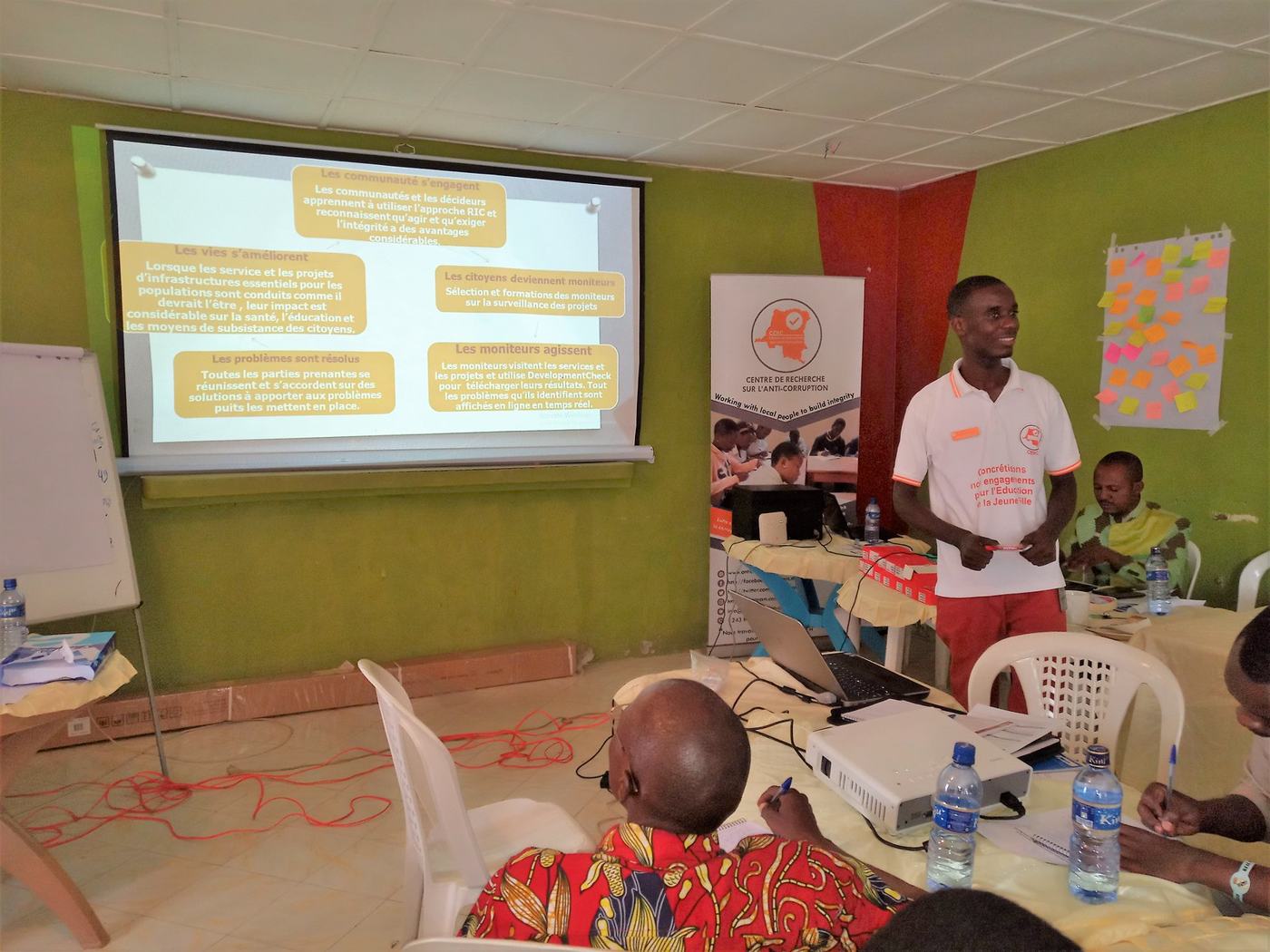
Background. CERC’s 2017–2021 strategy, More inclusive youth engagement in improving public services in South Kivu, was adopted on 15 July 2017, three months after CERC was founded, and came with an operational plan in September 2017. It aimed for strong links between the users and the providers of education and health services, with young people, girls and women at the heart of decisions, in the territories of Uvira and Walungu and the city of Bukavu.
Implementation in a difficult context. The 2018 elections, the Ebola epidemic in the East, insecurity in South Kivu and the Covid-19 pandemic in 2020 and 2021 – which closed schools and cut funding – weighed on implementation. CERC had to close its Uvira and Bukavu offices during the pandemic, and it began working in Kinshasa.
Why this report. The evaluation aims both to prove and improve: to account to our partners for what we did with their trust, and to learn the lessons of our first strategy to make the 2022–2026 strategy, adopted in January 2022, succeed.
Methodology. The evaluation, an internal one, is anchored in the six OECD-DAC criteria – relevance, coherence, effectiveness, efficiency, impact and sustainability – organised in three pillars: the strategy and its plan (pillar 1), the effectiveness and efficiency of our programmes, through three case studies (pillar 2), and the value, impact and sustainability of our work (pillar 3). It rests on a review of 14 documents, our audited accounts and the archives of our website; it includes no new interviews.
Key figures
US$251,077 received from 2017 to 2021, for US$575,000 planned (44%) · 54 Integrity Clubs and 810 students trained · 32% of the problems reported by students fixed · 4 of 4 financial years audited · 5 of 24 targets met, 7 partly met, 8 not met and 4 not measured.
Overall performance. The strategy laid CERC’s foundations: a method that works – Integrity Clubs –, accounts audited every year and a voice recognised up to the United Nations. But it reached only part of its targets: with 44% of the planned funds, clubs and students trained stayed five times fewer than planned.
Pillar 1: the strategy and its plan. The diagnosis was right and the choice of young people relevant, as confirmed by our 2017 survey of 980 households. The health component was hardly implemented, and the plan’s targets were set without regard to the funding secured. Our annual reports followed four objectives that differ from the plan’s, which made monitoring difficult.
Pillar 2: our programmes. SHINE trained 810 students in 54 Integrity Clubs in Uvira and Bukavu and fixed 32% of the problems reported, for about US$163 per student. The small 2020 projects were managed rigorously, to the point of returning unspent funds to the donor. In 2021, Youth Excel and the year zero of Students Acting prepared our work in Kinshasa.
Pillar 3: value, impact and sustainability. Club students know how to monitor and report, schools were repaired, and CERC became a partner of the education authorities and an NGO in special consultative status with ECOSOC. But 53% of funds came from a single donor, and CERC had neither a reserve nor own funds before 2021.
What should change. Set targets that match the funding secured, and review them every year; diversify donors and build a reserve; report on the plan’s targets in every annual report; and embed the clubs in school rules so that they live without funding.
Overall conclusion. A sound first strategy, carried by a small team, that learned faster than it grew. The 2022–2026 strategy must set targets that match our means, and raise means that match our ambitions.
Organisation of the report. Chapter 1 presents the methodology, its questions, pillars, sources and limits. Chapter 2 presents the findings, pillar by pillar, and a synthesis against the DAC criteria. Chapter 3 presents the recommendations, lessons and suggestions in a table, with their category and criticality. The annexes present the evaluation requirements, the choice of case studies, the team, the work plan, the documents reviewed and the funds by donor.