In 2021, Year Zero allowed CERC to gather evidence with students, teachers, parents, civil society and education officials, to build its team’s skills and to write the project with them.
Year Zero prepared the Students Acting for Accountability and Quality of Education project. CERC received the Year Zero funds in mid-June 2021, about three months after the period began, and adjusted its work plan; because of Covid-19, workshops were limited to 20 participants, so more of them were held. The full proposal process ended on 21 January 2022.
May–July 2021Evidence from the field
CERC consulted 534 students (271 boys and 263 girls), 39 principals and 50 teachers, 21 parents’ committees, 19 representatives of 8 civil society organisations working in education, and 12 senior education officials. It used mixed methods: participative workshops on what motivates young people to act, formal meetings with the Provincial Directorates and Ministries of Education of South Kivu and Kinshasa and the National Ministry of Education, and 16 key informant interviews. Evidence was collected over 40 days, and analysed and written up in three weeks; US$7,540 was spent on it, from the stakeholder analysis and data collection to the theory of change, the GESI strategy and the reports.
The study of the Integrity Club model showed that:
- students aged 14 to 18 are highly positive agents of change, motivated to improve the services and projects delivered to their communities;
- teaching young people the benefits of integrity, and the skills to practise and demand it, gives them the confidence to choose integrity over corruption;
- Integrity Clubs encourage young people to keep taking part in civil society;
- education officials and service providers who expect to be monitored by students are encouraged to act with integrity;
- even where the status of girls is low, over 40% of the monitors trained by CERC are girls.
July 2021Four consultative workshops
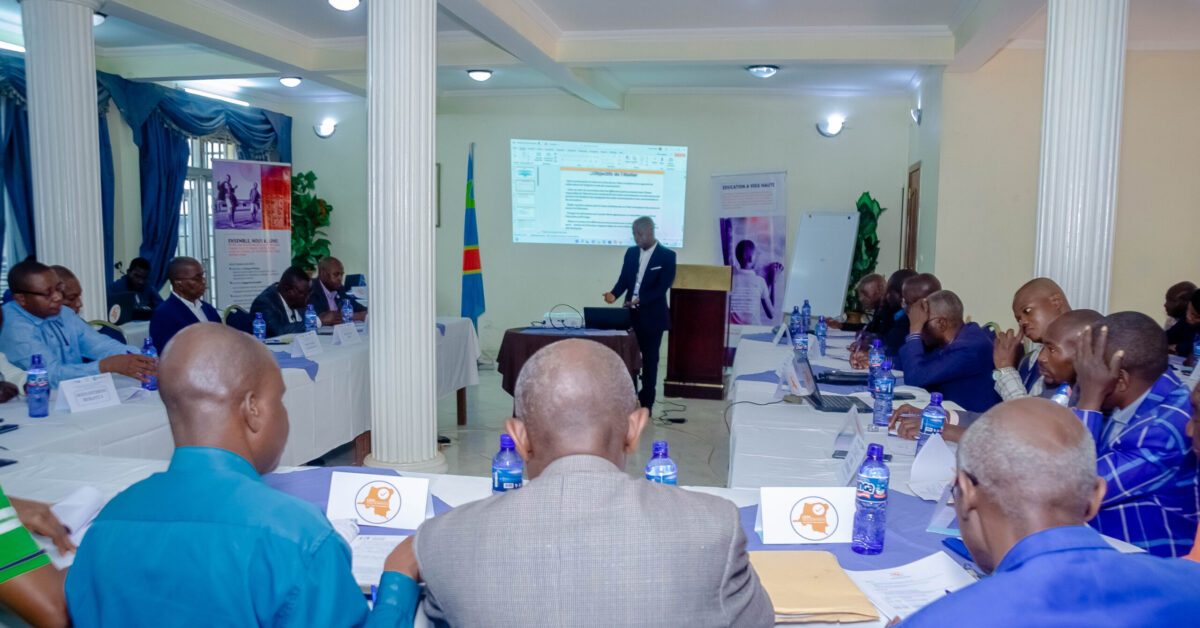
In July 2021, four consultative workshops brought together organisations working in education and Ministry of Education officials to discuss the challenges of transparency and accountability in the sector and how to overcome them. The civil society side included the national association of parents of students, the parents’ associations of Catholic and Protestant schools, three teachers’ unions, the African Zone League for the Defence of Children and Students’ Rights and the National Coalition for Education for All; 9 participants from 6 faith-based education coordinations also took part. With 12 senior officials of the Ministry of Education, the workshop focused on bringing Integrity Clubs into every secondary school and the Integrity Education Handbook into the national curriculum.
July–September 2021Writing the project
Building on these results, the whole programme team defined the project’s context, objectives, outcomes and outputs, its theory of change and overall strategy, the monitoring framework and the budget, and wrote the proposal. The Year Zero produced a gender equality and social inclusion (GESI) strategy, a KAP baseline survey, the theory of change and a research report with recommendations for integrity education and student-led monitoring in secondary schools.
2021Stronger skills
- Training of the programme team in programme development and management, and in monitoring, evaluation and learning;
- training in adaptive management and theory of change, and in bringing human rights, gender and inclusion into programme design, implementation and evaluation;
- in October 2021, training of 6 programme staff in high-level advocacy and policy engagement;
- a due diligence action plan, drawn up during Year Zero and implemented, which strengthened CERC’s governance and management systems.
LessonsWhat Year Zero taught
- Key stakeholders must take part in every phase of the proposal, not only in the initial analysis; their participation made the project respond to the need for more advocacy and accountability in education.
- The programme team needs strong skills in research, project development and budgeting.
- Female students reported sexual harassment and sexual bribery in exchange for grades; there was not enough time to study these issues, which CERC committed to research further.
CERC rated the process followed during Year Zero as satisfactory, and the final products – proposal, logical framework, budget and monitoring framework – and the learning outputs as highly satisfactory.