

US$962 million
reported disbursed by donors to implementing partners;
Press releaseBy CERC
Of US$962 million reported disbursed by donors for the Ebola response in the DRC, barely US$200 million was traced on the ground. Africa CDC wants the remaining US$700 million-plus accounted for. What CERC is calling for.
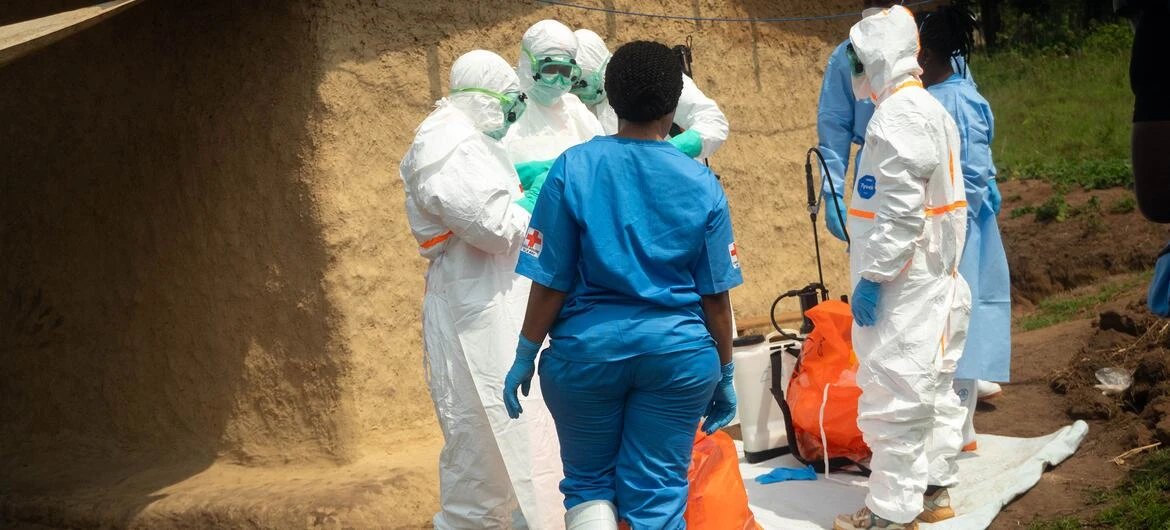
Kinshasa, 16 October 2026 – Of the US$962 million that donors say they disbursed for the Ebola response in the Democratic Republic of the Congo, barely more than US$200 million could be traced to the organisations fighting the epidemic on the ground. More than US$700 million remain unaccounted for. The finding was presented on Wednesday 14 October in Kinshasa by the Director General of the Africa Centres for Disease Control and Prevention (Africa CDC), Dr Jean Kaseya, who denounced a lack of transparency in how the funds are tracked.
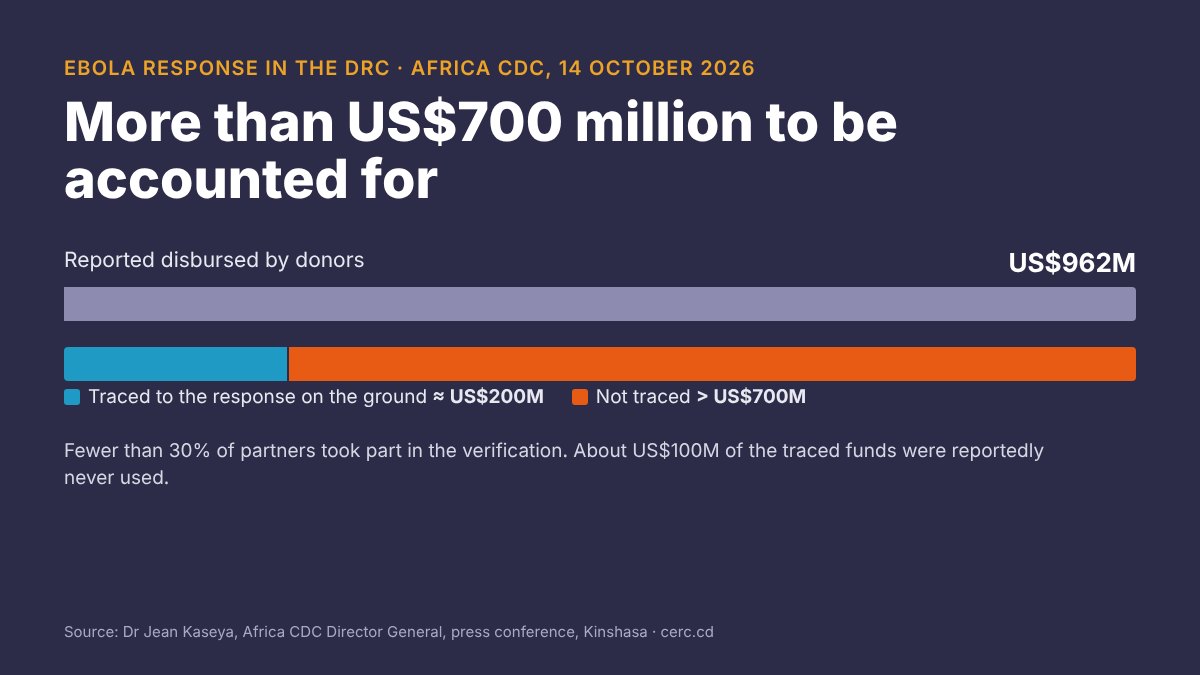
reported disbursed by donors to implementing partners;
of these partners attended the verification meeting held by the National Institute of Public Health (INSP);
traced among the partners who attended;
of these funds were reportedly never used and are still held by some partners;
whose destination is still to be established.
According to Dr Kaseya, the gap came to light through a verification carried out with the Congolese health authorities. Donors provided precise data showing the disbursement of US$962 million; the INSP then called the implementing partners together to trace the funds. Fewer than one in three answered the call.
“Donors gave us precise evidence that US$962 million was disbursed to implementing partners. At the meeting held to trace these funds, fewer than 30% of the partners took part. Among them, we could trace only a little over US$200 million. We were also told that about US$100 million still exists and has never been used. This means these funds are still held by some partners.”
Dr Jean Kaseya, Director General, Africa CDC
For the head of Africa CDC, the question is not the US$200 million already identified, but the roughly US$700 million that has not been clearly traced. He announced that the investigations will continue, to establish where the remaining funds went and to obtain more accountability from the organisations concerned.
“I am talking about the difference between the US$962 million announced by donors and the amounts reported by the partners who attended this meeting. That is more than US$700 million to look for. These funds exist and we will keep up this fight. I can tell you that we will not let go.”
Dr Jean Kaseya
The Ministry of Health declared the 17th Ebola epidemic in the DRC on 15 May 2026, caused by the Bundibugyo strain. First reported in Ituri, it has spread to other provinces, including North Kivu and South Kivu: by 5 September 2026, the National Institute of Public Health counted 6,604 confirmed cases and 3,175 deaths. In provinces coming out of war, where health centres have been looted and many lack medicines, every dollar of the response counts.
Ebola funds have been diverted before. In March 2020, a former Minister of Health was sentenced to five years of hard labour for misappropriating funds meant for the fight against Ebola during the 2018–2020 epidemic in the east. Fighting corruption in emergency funds is part of fighting the epidemic.
Every dollar of emergency aid that does not reach health centres is a dollar taken from patients. The Centre de Recherche sur l’Anti-Corruption (CERC) welcomes the work of Africa CDC and the INSP, and calls for:
These statements reopen the debate on transparency and accountability in the management of international funding for health emergencies in the DRC, a country that has faced several major epidemics in recent decades. It is one of the areas of our Strategy 2027–2030: health centres that receive what is meant for them, everywhere.
Sources: statements by Dr Jean Kaseya, Director General of Africa CDC, at a press conference in Kinshasa on Wednesday 14 October 2026 (Africanews); situation reports of the National Institute of Public Health (INSP); Africanews, 24 March 2020.
The Centre de Recherche sur l’Anti-Corruption (CERC) is a Congolese non-governmental organisation founded in April 2017 in South Kivu. With young people at its heart, CERC works with schools, communities, public institutions and partners to promote transparency, accountability and integrity in the Democratic Republic of the Congo. It has held special consultative status with the United Nations Economic and Social Council (ECOSOC) since 2021. Learn more: Who we are.
 Feature storyCase study: how DigitalOcean’s cloud credits keep citizen monitoring online in the DRC
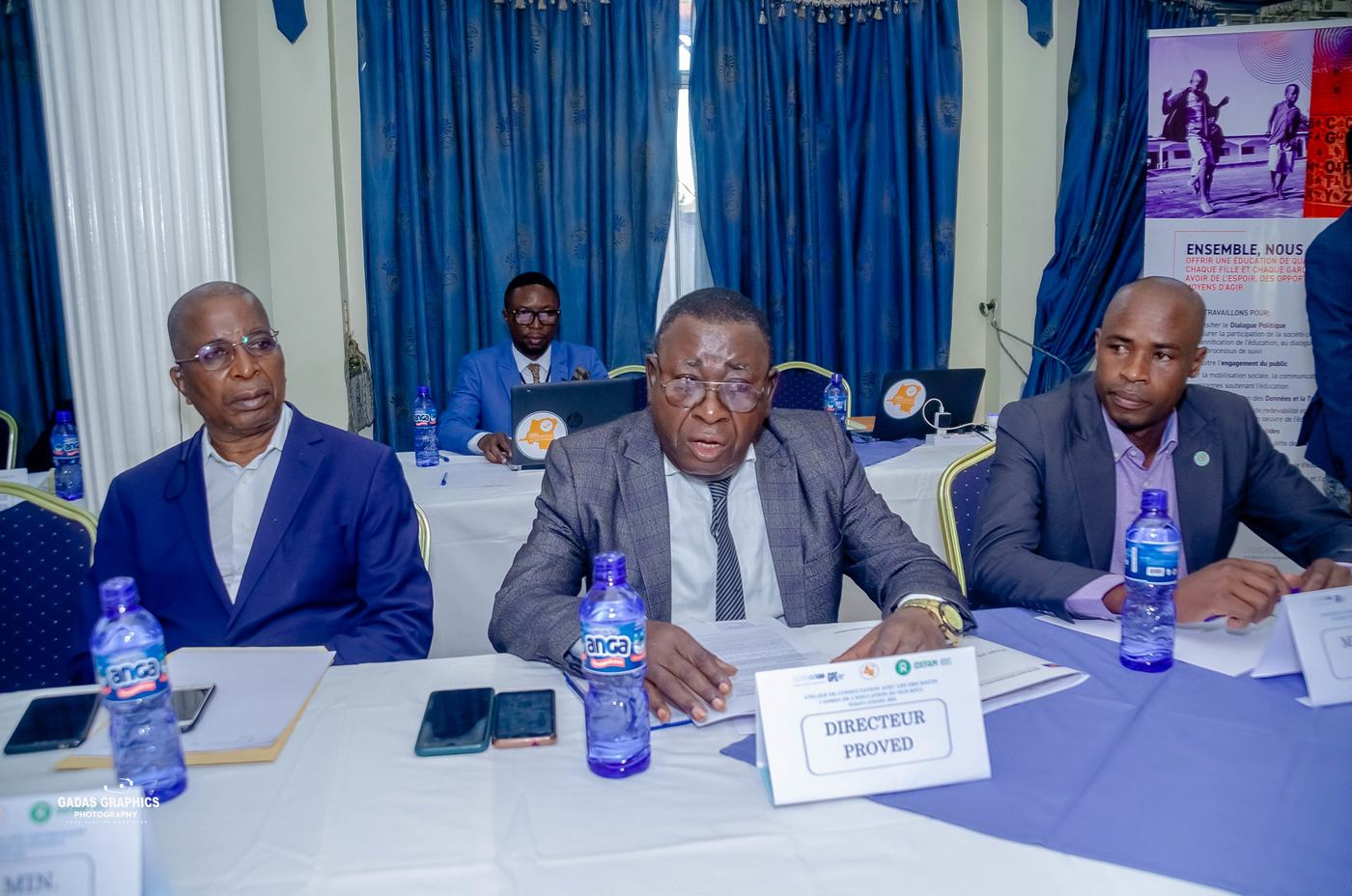 Feature storyFighting Corruption in Schools: CERC and APNAC DRC to propose Legislative Initiative to the National Assembly of the DRC
 Press releaseThe DRC leaves the FATF grey list: a CERC recommendation implemented
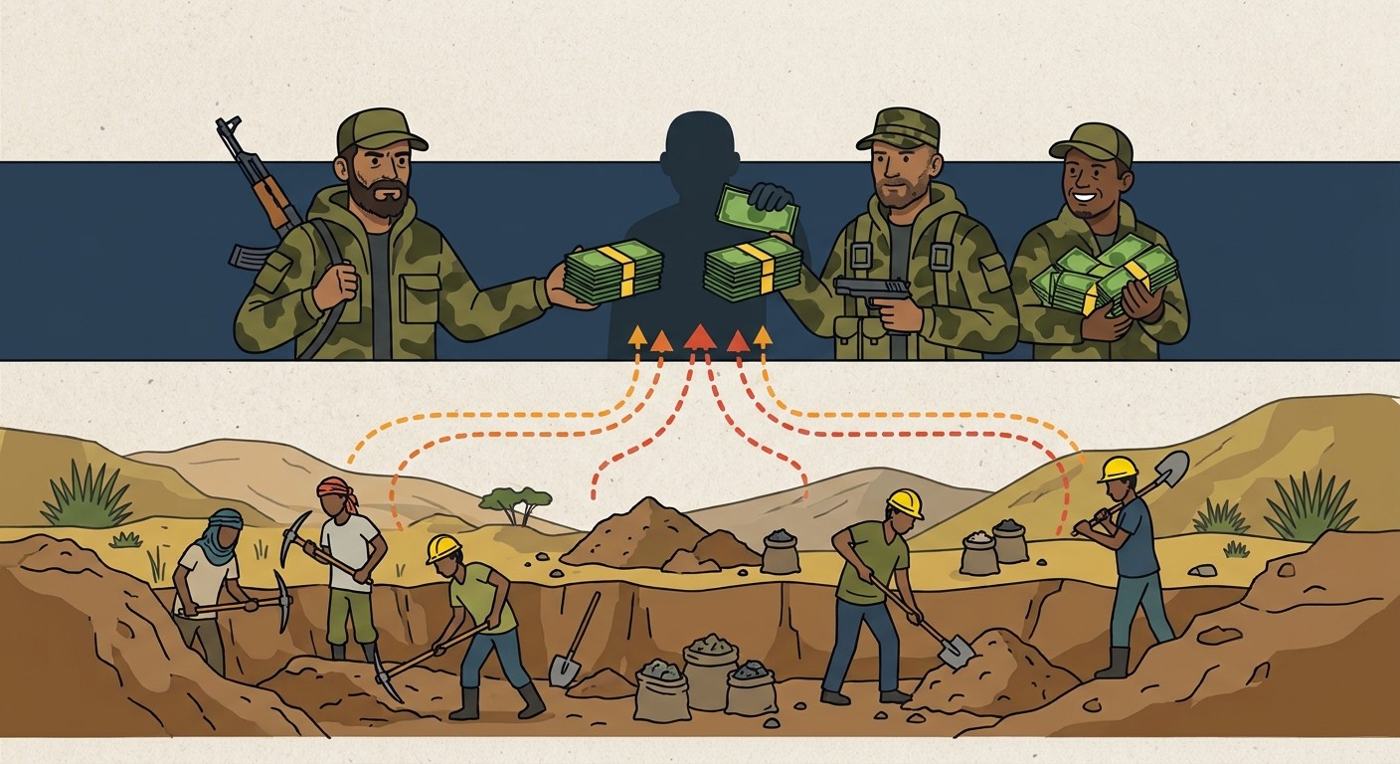 Press releaseConflict gold now funds the ISIL-affiliated ADF in the DRC

CERC’s assistant
Hello, I’m Exaucée, CERC’s assistant. How can I help you?
You can write your question, we will reply instantly.
Do not share personal information here. To report a case of corruption, use the whistleblowing page: it protects you.
Report what you see in your school or health centre. Your feedback helps make education and health services in the DRC better and more transparent.
 EduCheckMonitor your school: teacher attendance, school fees, water and sanitation, equipment.Go to EduCheck (opens in a new tab)
 HealthCheckMonitor your health centre: quality of care, medicines, fees and hygiene.Go to HealthCheck (opens in a new tab)
 GovCheckA problem in your neighbourhood or with a public service? Report it to your city or commune, and advocate until it is solved.Go to GovCheck (opens in a new tab)
 UNCAC TrackerFollow how the DRC implements the UN Convention against Corruption.Go to UNCAC Tracker (opens in a new tab)