

 Feature storyCase study: how DigitalOcean’s cloud credits keep citizen monitoring online in the DRC
Press releaseBy CERC
DRC: 1,600 companies illegally mining in South Kivu – how accountability in the mining sector can help end the war economy
At least 1,600 companies are mining South Kivu’s resources illegally, the province’s governor told French MPs. Where the minerals go, who profits – and how accountability in the mining sector can help end the war economy.
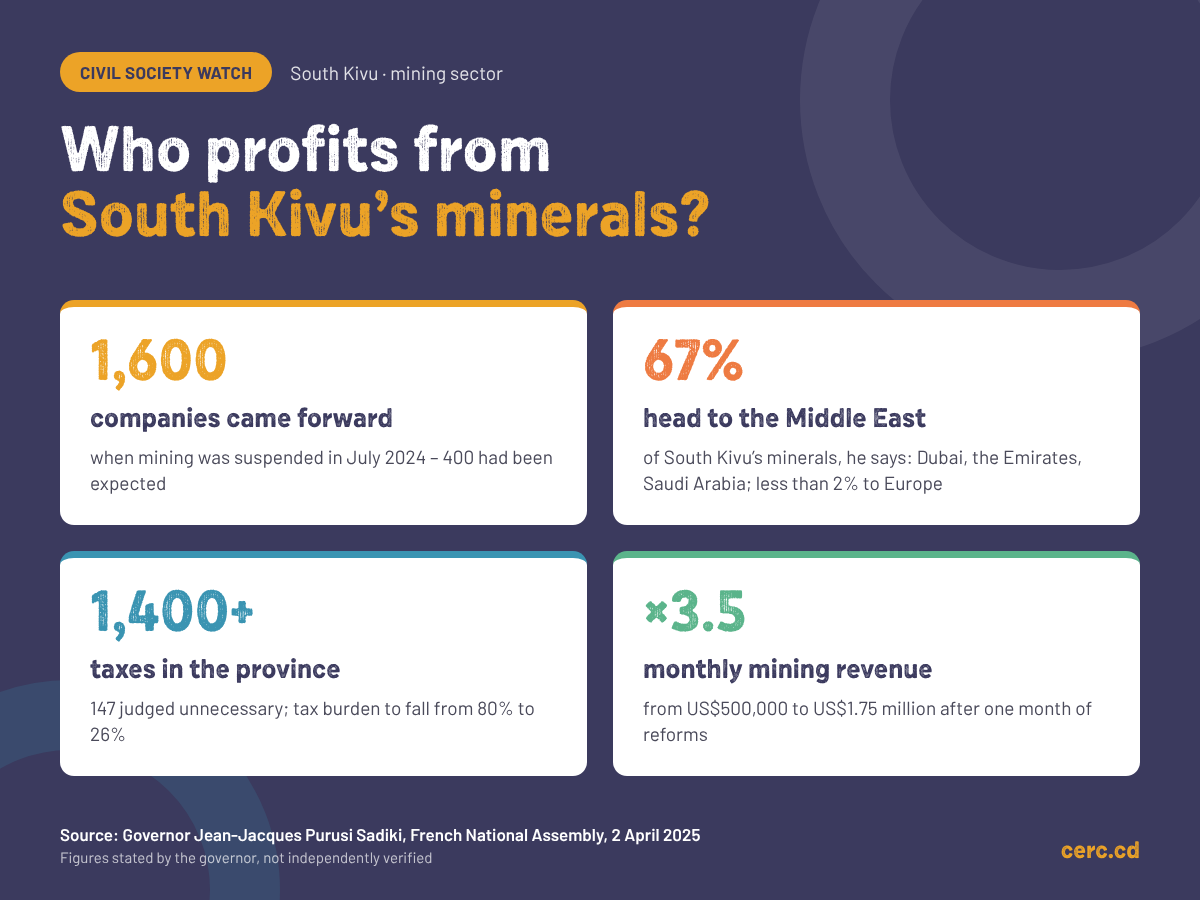
14 April 2025 – At least 1,600 companies are mining South Kivu’s resources illegally. The Governor of South Kivu, Jean-Jacques Purusi Sadiki, made the statement before the Foreign Affairs Committee of the French National Assembly on 2 April 2025, at a hearing on the security and economic situation in eastern Democratic Republic of the Congo (DRC). His figures describe a mining sector where most of the wealth escapes the State – and feeds the war.
1,600 companies where 400 were expected
When he took office in June 2024, the governor launched an overhaul of the mining sector. A month later, on 18 July 2024, an order suspended all mining activity in the province, so that the companies working there could be identified.
“We expected 400 companies, but 1,600 showed up – some had been operating for 8 to 10 years without permits, taxes or registration.”
Jean-Jacques Purusi Sadiki, Governor of South Kivu
Many of these companies, he said, have never paid taxes and hold neither an exploitation permit nor a research permit: they mine, transport and take the ore across the border. Most are Chinese-owned, and they are part of a wider network that exploits gold, coltan, cassiterite, copper and diamonds.
A province rich in strategic minerals
South Kivu holds gold, cassiterite (tin ore), coltan – essential to the electronics industry – and wolframite, used in aeronautics. These minerals are mined by artisanal and industrial methods, often illegally, which feeds trafficking and corruption.
Much of the ore leaves through neighbouring countries – Rwanda, Uganda and Burundi – before reaching international markets. This informal trade deprives the Congolese State of considerable revenue and finances an opaque network that sustains armed groups.
Where the minerals go
For the governor, as for UN experts, this network benefits Rwanda, which serves as a gateway for multinationals thanks to its infrastructure and supply chains: buyers reach Congolese minerals through the neighbouring country and bypass the DRC’s disorganised market. He put the gold smuggled out for refining in Rwanda, “which has set up refineries right on the border”, at 750 tonnes every six months – a figure that has not been independently verified.
On 17 March 2025, the European Union sanctioned Rwanda’s Gasabo Gold Refinery for contributing to the illegal extraction and trafficking of natural resources from eastern DRC (The EastAfrican). Kigali denies any involvement.
According to the governor, 67% of the province’s minerals go to the Middle East – Dubai, the United Arab Emirates and Saudi Arabia – and less than 2% to Europe; the rest goes to China. In January 2025, a report by the UN Group of Experts found that rebels had fraudulently exported at least 150 tonnes of coltan to Rwanda in 2024, from the Rubaya mines they control in North Kivu – the largest contamination of the region’s mineral supply chains on record (Reuters, via Mining Weekly). Too many foreign buyers still turn a blind eye to the origin of what they buy.
An economic war
For Governor Purusi Sadiki, the conflict in eastern DRC is driven by the economy: control of land, of trade and of minerals. “The M23 rebels, backed by Rwanda, align their progress with the location of mining sites,” he said. Rwanda says it has only taken defensive measures to “protect its sovereignty and territorial integrity” against the Democratic Forces for the Liberation of Rwanda (FDLR), which it considers an “existential threat” since they took refuge in the DRC after the 1994 genocide.
Rivalries between armed groups for the control of mining areas – the FDLR, Congolese Mai-Mai groups, the M23 and other local and foreign armed groups – largely fuel the conflict in South Kivu. CERC has documented how corruption and war feed each other: Conflict and corruption.
The cost for the people
The plundering of resources hits the population first. Artisanal mining often takes place in inhumane conditions, with forced labour, child labour and constant danger for the miners. Insecurity also disrupts agriculture, the main livelihood of many families: when farmers cannot reach their fields, food insecurity becomes chronic.
Reforms – and corruption at home
To end the tensions, the governor proposes a deal of “mining for peace, security and development”: bringing more European and American companies into the DRC’s mineral sector, in the hope that their presence will deter armed groups and stabilise the region. President Félix-Antoine Tshisekedi shares the view that Western interests can help restore order, and Kinshasa is negotiating a minerals agreement with Washington.
But the governor’s first months also show the obstacles at home: corruption and a crushing tax system of more than 1,400 taxes, 147 of which he judges unnecessary and wants to remove. He announced a cut in the tax burden from 80% to 26%, the banking of transactions and digital payment counters (Actualite.cd). According to him, the province’s monthly mining revenue rose from US$500,000 to US$1.75 million after a single month of reforms.
What CERC is calling for
Minerals that leave without a trace pay for weapons, not for schools or health centres. Accountability in the mining sector is a condition for peace. The Centre de Recherche sur l’Anti-Corruption (CERC) calls for:
- the publication of the list of the 1,600 companies, with the status of their permits, the taxes they pay and their real owners;
- monthly publication of the province’s mining revenue and of how it is spent, so that citizens can check the results of the reforms;
- fewer taxes, paid through banks and digital counters, with the receipts made public – fewer cash payments mean fewer opportunities for bribes;
- traceability of minerals from the mine to the refinery, and sanctions against buyers and refiners who process minerals from areas controlled by armed groups;
- transparent contracts in any new partnership with foreign companies or States, with independent monitoring by civil society and mining communities.
In its civil society report on the UN Convention against Corruption, CERC found that the DRC has no obligation to disclose the real owners of companies – one of the gaps that lets illegal operators hide. At the Conference of the States Parties to the Convention in December 2023, CERC spoke on the links between corruption, the financing of crime and conflict in eastern Congo: CERC at the United Nations: from the UNCAC conference to Nairobi. With GovCheck, citizens can already document and report irregularities in public projects and budgets.
Update, May 2026: mining suspended in Mwenga and Shabunda
On 22 May 2026, the Minister of Mines, Louis Watum Kabamba, signed a directive suspending mining activities for three months in the Mwenga and Shabunda territories of South Kivu, in response to illicit mining (Reuters). During the suspension, a special mission led by the General Inspectorate of Mines is to verify the legality of mining operations, to curb fraud and the illicit exploitation of ores in the province. Gold, cassiterite and coltan from South Kivu are mostly mined by artisanal miners.
In 2025, the DRC had already banned trade in minerals from dozens of artisanal mining sites in North and South Kivu, citing evidence that illegal supply was financing armed groups (Reuters). CERC calls for the findings of the inspection mission to be published, site by site, so that miners, communities and buyers know which operations are legal.
Sources: statements by Governor Jean-Jacques Purusi Sadiki before the Foreign Affairs Committee of the French National Assembly, 2 April 2025, as reported by Agence Ecofin (Bankable), 14 April 2025 and Actualite.cd, 3 April 2025; Reuters, 9 January 2025 and 25 May 2026.
About CERC
The Centre de Recherche sur l’Anti-Corruption (CERC) is a Congolese non-governmental organisation founded in April 2017 in South Kivu. With young people at its heart, CERC works with schools, communities, public institutions and partners to promote transparency, accountability and integrity in the Democratic Republic of the Congo. It has held special consultative status with the United Nations Economic and Social Council (ECOSOC) since 2021. Learn more: Who we are.
Feature storyCase study: how DigitalOcean’s cloud credits keep citizen monitoring online in the DRC Feature storyFighting Corruption in Schools: CERC and APNAC DRC to propose Legislative Initiative to the National Assembly of the DRC
 Press releaseConflict gold now funds the ISIL-affiliated ADF in the DRC
 Press releaseSASA: the US$6.5 million scale-up swept away by the closure of USAID


