

 Feature storyCorruption and governance in the DRC: CERC takes evidence from the ground to the UN2021–2025
Impact stories2021By CERC
Is the DRC keeping its anti-corruption commitments? The civil society report
The DRC ratified the UN Convention against Corruption in 2010. In 2021, the UNCAC Coalition asked CERC to check, for civil society, whether the country keeps its word. CERC’s report reviews prevention and asset recovery and makes around a hundred recommendations – among them the anti-corruption law now before Parliament.

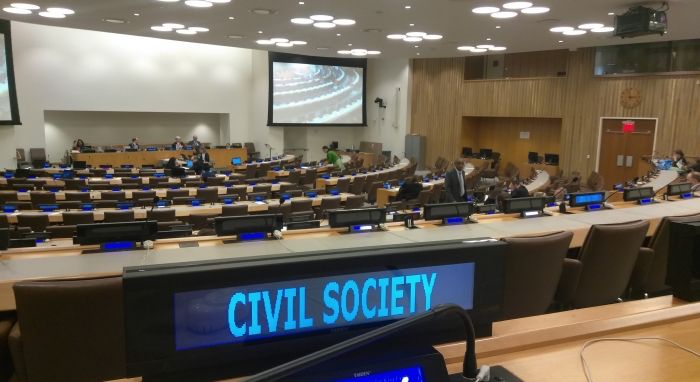
On 23 September 2010, the DRC ratified the United Nations Convention against Corruption (UNCAC), the most comprehensive global agreement against corruption. Each State party is reviewed by its peers on how it applies the Convention, and Articles 5 and 13 give civil society a role in the fight against corruption. In 2021, CERC took up that role: to look at what the DRC has done, in law and in practice, and to say what is still missing.
A mandate from a global network
CERC joined the UNCAC Coalition, a global network of more than 350 civil society organisations, in November 2020.
On 14 May 2021, CERC’s Executive Director, Heri Bitamala, and Musa Nzamu Jonathan met Fidèle Mawete Fakana, the DRC’s representative in the review of the Convention, at the Ministry of Justice to discuss the place of civil society in the review.
In June 2021, the Coalition entrusted CERC with the civil society review of the DRC for the second review cycle, on Chapter II (preventive measures) and Chapter V (asset recovery). In August, seven CERC staff were trained on the Convention and its review mechanism.
Checking the law against practice
Between 11 June and 1 December 2021, CERC met state and non-state actors to assess how the Convention is applied, not only in the texts but in daily practice: prevention policies and bodies, recruitment in the public service, codes of conduct and asset declarations, whistleblower protection, political financing, public procurement, public finances, judges and prosecutors, private sector transparency, access to information, and the fight against money laundering and for the recovery of stolen assets.
What the report found
The report recognises real efforts – new anti-corruption bodies, including the Agency for the Prevention and Fight against Corruption (APLC) created in 2020, public finance reforms and budget statements published online – but it shows how far practice lags behind the commitments:
- no specific anti-corruption law: the draft laws prepared after the 2009 national forum met political resistance;
- an average of US$15 billion lost every year to fraud, corruption and the mismanagement of public funds;
- anti-corruption bodies without the legal safeguards they need to work independently;
- public recruitment based on political and family ties, and an investigation into more than 130,000 ‘ghost’ workers on the state payroll, still not concluded;
- an estimated 80% of public contracts awarded by mutual agreement in 2019, and no safe channel to report fraud in procurement;
- no law on access to information, and a toll-free number to report corruption that few people know about;
- no obligation to disclose the beneficial owners of companies.
Around a hundred recommendations
The report, published in 2022 with the UNCAC Coalition, shares around a hundred recommendations with the Congolese government. Among the main ones:
- strengthen the capacity and full independence of anti-corruption and anti-money laundering investigation bodies;
- set up a structure to monitor public officials’ asset declarations, digitise filing and increase penalties for failing to declare;
- criminalise the illicit enrichment of civil servants, public officials and magistrates;
- adopt a law on access to information, a law on the protection of whistleblowers and an anti-corruption law;
- involve civil society widely in the review, and publish the DRC’s full country review report.
Read the report in English or French, and its findings and recommendations by topic: UNCAC implementation monitoring.
From the report to change
CERC carried the report’s messages to the national debate. In October 2021, invited as an expert to the Anti-Corruption States-General, it discussed the transparency of the review and the role of civil society with government officials.
It also took them to the United Nations. In December 2023, at the Tenth Conference of the States Parties to the Convention in Atlanta, CERC spoke online on the links between corruption, the financing of crime and conflict in eastern Congo, drawing on the report.
One of the report’s key recommendations is now on Parliament’s agenda: on 28 September 2026, the National Assembly declared admissible the government’s anti-corruption bill, which provides for whistleblower protection, asset declarations and asset recovery.
CERC keeps following the DRC’s commitments under the Convention with its UNCAC Tracker app.
About CERC
The Centre de Recherche sur l’Anti-Corruption (CERC) is a Congolese non-governmental organisation founded in April 2017 in South Kivu. With young people at its heart, CERC works with schools, communities, public institutions and partners to promote transparency, accountability and integrity in the Democratic Republic of the Congo. It has held special consultative status with the United Nations Economic and Social Council (ECOSOC) since 2021. Learn more: Who we are.
Feature storyCorruption and governance in the DRC: CERC takes evidence from the ground to the UN2021–2025 Feature storyCERC gets its proposals into the national anti-corruption strategy2021
 Feature storyA global fight: CERC joins more than 350 organisations against corruption2020
 Feature storyAn alert system for citizens to report corruption within the justice system2024


