

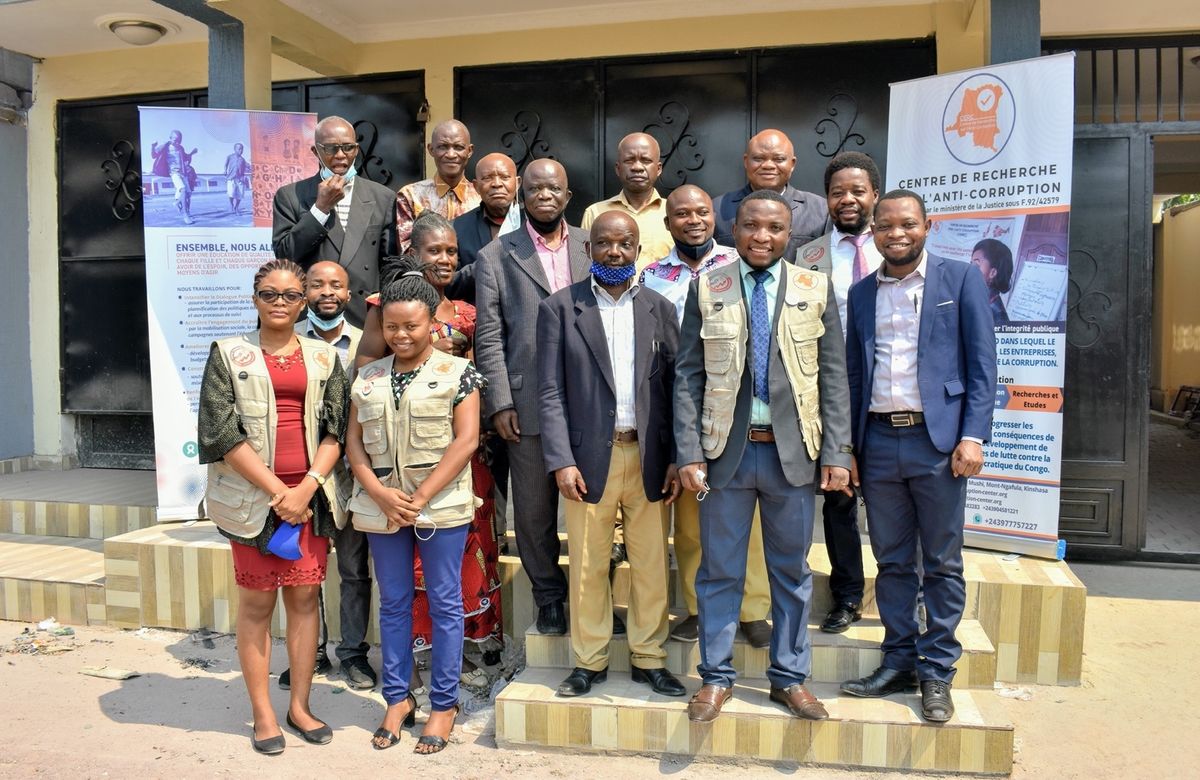
 Feature storyMore than 600 education actors mobilised for corruption-free schools2021
Impact stories2021–2025By CERC
South Kivu and Kinshasa: thanks to advocacy by CERC-trained students, 150 schools repair their facilities
With the Global Partnership for Education, through Education Out Loud and Oxfam IBIS, CERC took Integrity Clubs to 150 secondary schools in South Kivu and Kinshasa: 204 clubs, 2,250 students trained as monitors and one problem in three fixed.
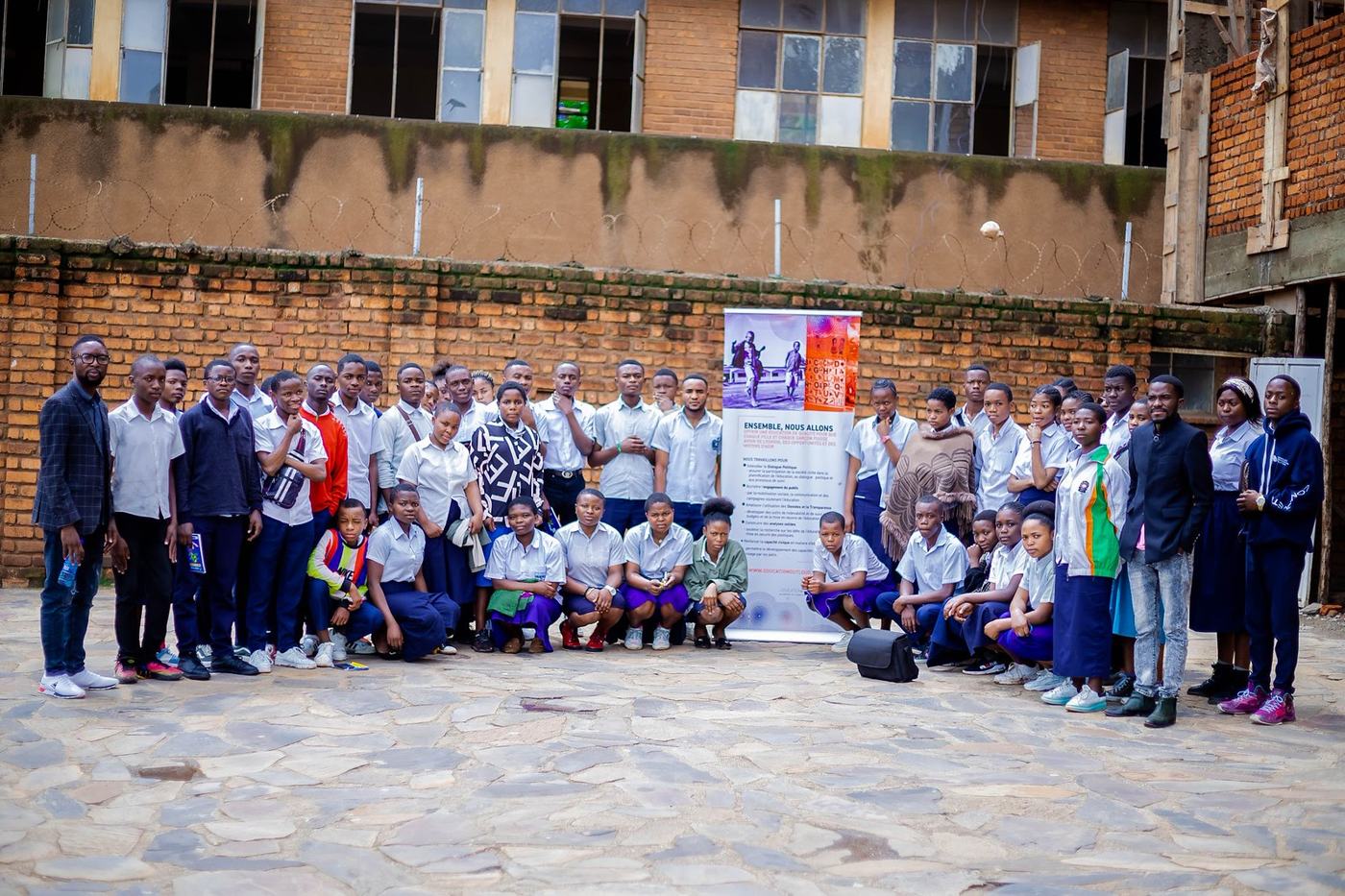
Having proved itself in South Kivu – from 20 schools in Uvira in 2017 to 54 clubs in Uvira and Bukavu by 2020 – the Integrity Club model was ready to scale up. In 2021, CERC won funding from the Global Partnership for Education, through Education Out Loud (Operational Component 2) with Oxfam IBIS, for the project Students Acting for Accountability and Quality of Education.
The project ran for 18 months, from February 2022 to August 2023, in 6 municipalities of South Kivu and 6 municipalities of Kinshasa. It supported the DRC Education and Training Sector Strategy 2016–2025, so that students – especially girls – receive accountable, inclusive and equitable quality education.
Year Zero: designing the project with the people concerned
Before the project came a preparation year. CERC received the Year Zero funds, US$23,986, in mid-June 2021, and because of Covid-19 held more, smaller workshops. In 40 days, the team heard from 534 students (271 boys and 263 girls), 39 school principals and 50 teachers, 21 parents’ committees, 19 representatives of 8 civil society organisations and 12 senior education officials, and surveyed knowledge, attitudes and practices in 41 secondary schools.
The consultations also brought a hard truth to light: female students reported sexual harassment and sexual bribery in exchange for grades. CERC committed to researching these issues further.
Four objectives
By the end of the project, the aim was that:
- 50 senior education officials, 6 civil society organisations and 10 parliamentarians work closely with CERC to embed anti-corruption and accountability in the education sector;
- 2,250 students aged 14 to 19 are engaged and supported to become agents of change and demand that education reforms meet their needs;
- 150 secondary schools are supported to embed Integrity Clubs for the long term;
- student-led advocacy and campaigns build wider support for anti-corruption and accountability in education.
How it works
Students are trained as community integrity monitors in Integrity Clubs. They monitor school infrastructure and the delivery of education services and share their findings on EduCheck, the app CERC launched in March 2022. The problems they identify are discussed and solved in Education Clusters, where parents, students, teachers and authorities work together, and the data feed advocacy with education authorities and parliamentarians.
Schools, teachers and students on board
Memoranda of understanding were signed with the heads of the 150 partner schools – 90 in Bukavu and 60 in Kinshasa. In September 2022, 138 school principals and 278 teachers from these schools learned, over three days, the integrity-building approach and how to coach the students who monitor their school.
From 2 to 15 November 2022, nine two-day workshops trained 300 students – 180 from South Kivu and 120 from Kinshasa – who shared what they learned with the other members of their clubs. In December, each of the 2,250 students received an integrity education manual and a monitoring guide.
The results
In 2022, CERC established 204 Integrity Clubs in South Kivu and Kinshasa, and 2,250 students aged 14 to 19 were trained to monitor education services in their schools. Their advocacy got 33% of the problems they identified fixed – from inadequate classrooms to sanitation.
By the end of March 2023, CERC staff had trained 450 monitors, who trained the other members of their clubs – 1,350 students in Bukavu and 900 in Kinshasa. The clubs had held 1,200 meetings on integrity, transparency, gender and inclusion; 168 principals and 294 teachers had been trained to supervise them; 150 Education Clusters – 90 in Bukavu and 60 in Kinshasa – were up and running; and radio programmes on Radio Maria in Kinshasa and Radio Maendeleo in Bukavu carried the clubs’ message.
From schools to policy
On 28 July 2022 in Bukavu, a consultation workshop led to a memorandum of understanding with the Ministry of Primary, Secondary and Technical Education, through the Provincial Directorate of Education of South Kivu 1, to bring Integrity Clubs into every secondary school in South Kivu.
In 2023, two workshops in Kinshasa and Bukavu brought together 97 policymakers. More than 50 education officials – among them the Secretary General for Education, the provincial ministries and directorates, the Agency for the Prevention and Fight against Corruption (APLC) and the Observatory of Corruption Monitoring and Professional Ethics (OSCEP) – and 10 parliamentarians expressed broad support. With APNAC DRC, CERC drafted two bills on Integrity Clubs and integrity education, taken to the National Assembly in April 2024.
Every dollar accounted for
CERC received US$361,361 in 2022, in two transfers on 17 March and 21 October, and US$68,816 in January 2023: US$430,177 in all. With the US$751 left from Year Zero, the project spent US$430,928 – US$273,341 in 2022 (audited) and US$157,587 in 2023 (audited by DWAC; the audit report is not yet published).
What the project leaves behind
When the project ended in August 2023, it left Integrity Clubs recognised by the school administration, a bill before the National Assembly and students trained to monitor their schools with EduCheck.
The next step that did not happen: every secondary school in four provinces
The results caught the attention of a new donor. In 2023, USAID’s Development Innovation Ventures (DIV) invited CERC to submit a proposal to scale up Integrity Clubs and EduCheck. The proposal was validated in 2024: CERC passed every stage of due diligence and the contract was signed.
The new project, Students Acting for Social Accountability (SASA), budgeted at US$6.5 million for 2025–2027, was to bring Integrity Clubs and EduCheck to every secondary school in four provinces, including South Kivu, North Kivu and Kinshasa, under a new agreement with the Ministry of Education to incorporate them in all secondary schools of the selected provinces.
Unfortunately, this ambition was not realised: USAID was closed in 2025 and every commitment was cancelled. The model and the tools remain, and CERC is looking for partners to take them to every school.
Read more: Integrity Clubs: a model first launched by CERC in Uvira to transform Congolese schools.
About CERC
The Centre de Recherche sur l’Anti-Corruption (CERC) is a Congolese non-governmental organisation founded in April 2017 in South Kivu. With young people at its heart, CERC works with schools, communities, public institutions and partners to promote transparency, accountability and integrity in the Democratic Republic of the Congo. It has held special consultative status with the United Nations Economic and Social Council (ECOSOC) since 2021. Learn more: Who we are.
Feature storyMore than 600 education actors mobilised for corruption-free schools2021 Feature storyCERC gets its proposals into the national anti-corruption strategy2021
 Feature storyIs the DRC keeping its anti-corruption commitments? The civil society report2021
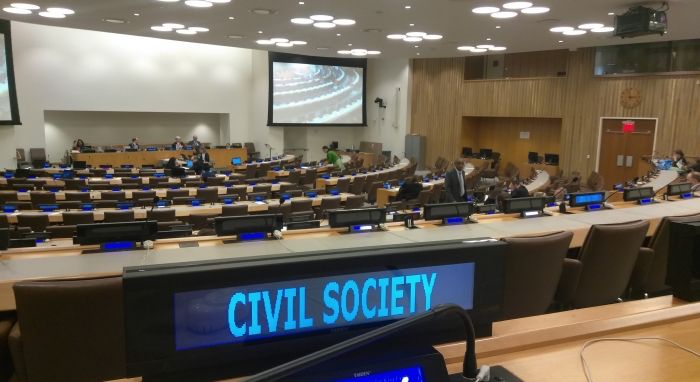 Feature storyCorruption and governance in the DRC: CERC takes evidence from the ground to the UN2021–2025


